








































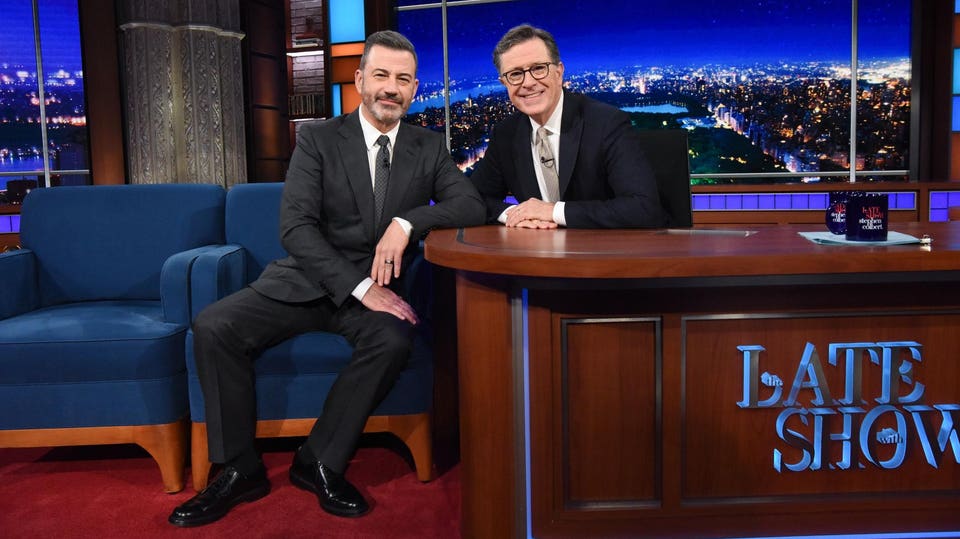
Late-night hosts Jimmy Kimmel and Stephen Colbert have expressed strong opposition to the Federal Communications Commission (FCC) enforcing its “equal time” mandate on their shows. This directive requires networks to provide equal airtime to opposing political candidates, a move Kimmel described as a “crackdown” intended to “stifle” political discourse on late-night television.
The controversy began when Kimmel briefly mentioned the FCC’s notice in his monologue on March 15, 2024. He highlighted that former President Donald Trump continues his “war on talk shows,” referencing a post on Truth Social where Trump claimed that the FCC was working to restrict political interviews. In his subsequent monologue, Kimmel referred to FCC Chairman Brendan Carr as “Brendan Cartel” and criticized the agency for “reinterpreting long-agreed-upon rules to stifle us.”
Kimmel elaborated on the history of the “equal time” mandate, explaining that it was established when radio was the main form of broadcast media. He pointed out that late-night shows have been operating under an exemption from this rule since 2006, following an appearance by then-California Governor Arnold Schwarzenegger on “The Tonight Show.” Kimmel argued that Carr’s efforts are aimed at silencing viewpoints that differ from his own, stating, “He’s doing everything he can to shut us up the easy way or the hard way.”
Furthermore, Kimmel highlighted the decline in broadcast television viewership, noting that it once represented 100% of television watching but now accounts for only about 20%. He emphasized the dominance of networks like Fox News and Newsmax, which he claims promote a constant stream of pro-Trump content. Kimmel concluded by expressing uncertainty about the implications of the FCC’s actions, saying, “I have no idea what the outcome of this is going to be. We’ll find out.”
Colbert joined the conversation during his show on the same night, addressing the FCC’s move directly. “I got to watch what I say about Trump because Johnny Law is once again coming after yours truly here,” he quipped, eliciting boos from the audience. He referred to a New York Times headline that described the FCC’s action as a “new crackdown on late-night TV,” humorously suggesting that it has significant implications for his show, especially since CBS has opted not to renew it for another season.
Colbert further remarked, “My lawyer has warned me not to talk about these new crackdown rules,” implying that the FCC’s actions are an attempt to silence his commentary alongside Kimmel and fellow host Seth Meyers. In a playful jab at the FCC, Colbert said, “Hey, I’m flattered you think that appearing on my show has the power to affect politics in any way…if our government had turned out the way I had chosen, you would not have the power to make this announcement.”
The FCC’s enforcement of the “equal time” rule highlights an ongoing tension between regulatory bodies and media platforms, particularly in an era of declining traditional television viewership and the rise of digital media. As late-night hosts navigate these new challenges, the implications for political commentary and public discourse remain to be seen.
























