








































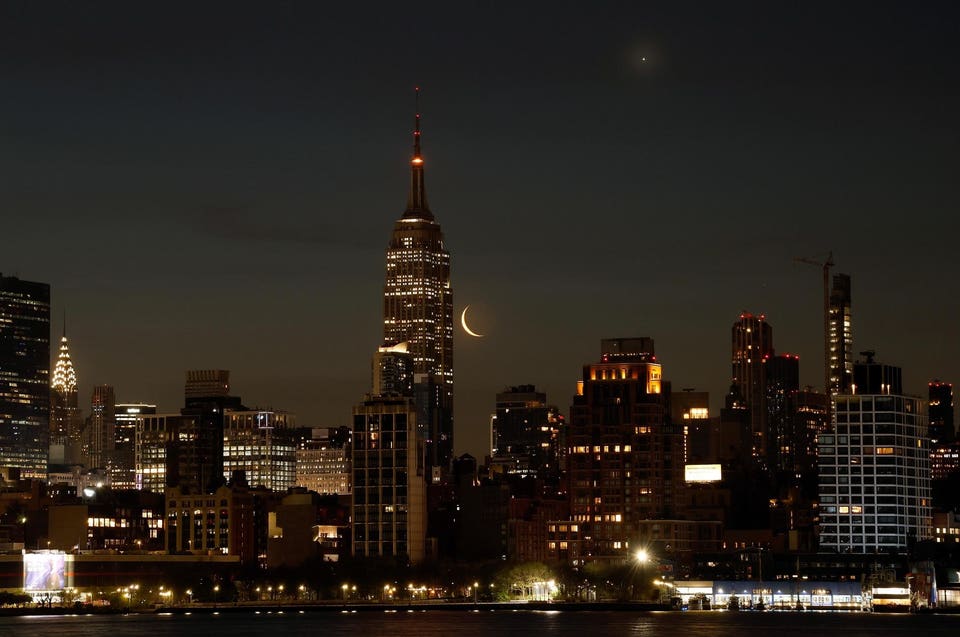
Stargazers across North America will have the opportunity to witness a beautiful alignment of the crescent moon and Saturn on January 22, 2024. The celestial event will take place shortly after sunset, as the moon appears just below the ringed planet in the west-southwest sky. This pairing is significant, as it represents one of the last easy chances to view Saturn before it becomes less visible against the sun’s glare.
The moon will be illuminated at approximately 17%, which should make it bright enough to spot with the naked eye. Additionally, observers may catch a glimpse of “Earthshine,” a phenomenon where sunlight reflects off the almost full Earth onto the moon’s darkened side. To see both celestial bodies, viewers are advised to find a clear view of the horizon around 30-60 minutes after sunset, when twilight deepens.
Optimal Viewing Conditions
During this event, the moon will sit about six degrees beneath Saturn, equivalent to the width of three fingers held at arm’s length. Both will be positioned low in the sky, making timing and an unobstructed horizon crucial for optimal viewing. The moon will appear as a slender crescent, while Saturn will shine like a steady, pale golden star, easily outshining the surrounding twilight.
For those using binoculars, pointing them at the moon’s night side will enhance the visibility of Earthshine. This alignment marks the second of three consecutive nights when the moon and Saturn will appear close together, but the January 22 event is noted for its visually pleasing diagonal arrangement.
Upcoming Celestial Events
Astronomers and telescope enthusiasts can expect to see Saturn’s rings during this conjunction, though they will gradually become less distinct as Saturn moves lower in the sky. On January 23, observers can look for a 26%-lit waxing crescent moon positioned above Saturn, offering another chance to view this magnificent planet.
This close pairing serves as a final opportunity to see Saturn before it approaches its annual solar conjunction on March 25, 2024. At that point, Saturn will pass the far side of the sun as viewed from Earth, becoming less visible in the evening sky. It will eventually emerge in the pre-dawn sky before reaching opposition on October 4, 2024, when it will be at its most visible from Earth.
Stargazers are encouraged to take advantage of this celestial display, wishing them clear skies and wide eyes as they enjoy the wonders of the universe.
























