








































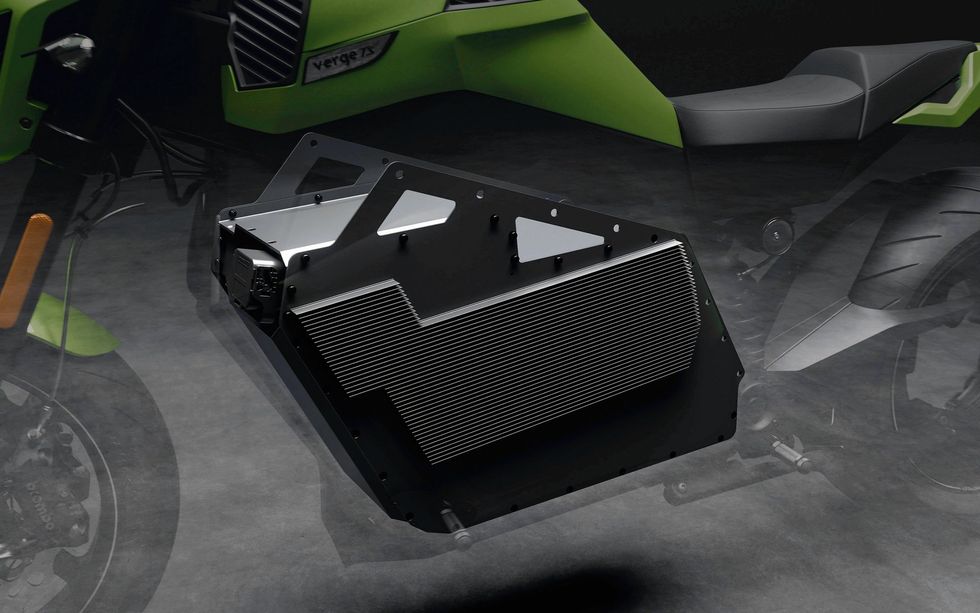
At CES 2026 in Las Vegas, Verge Motorcycles, alongside its tech spin-off Donut Lab, announced the launch of the first motorcycle powered by solid-state batteries. This innovative vehicle, named the Verge TS Pro, is set to begin shipping in the first quarter of 2026, marking a significant milestone in the race for advanced battery technology in electric vehicles.
Based in Estonia, Verge Motorcycles and Donut Lab aim to challenge established giants like Tesla and BYD, who have yet to successfully commercialize solid-state batteries. The Verge TS Pro will feature a unique battery system that replaces traditional lithium and liquid electrolytes with ceramics, enhancing safety and performance. Customers will have the option to choose between a 20.2-kilowatt-hour or a 33.3-kilowatt-hour battery pack, boasting an impressive energy density of 400 watt-hours per kilogram. This is a notable improvement over the 200-300 watt-hours per kilogram typical in current lithium-ion batteries.
Revolutionizing Electric Motorcycles
The Verge TS is designed to address common frustrations faced by electric motorcycle riders, such as limited range and lengthy charging times. The model’s large battery version is capable of traveling up to 600 kilometers (approximately 370 miles) on a single charge. With a peak charging rate of 200 kilowatts, the bike can recharge from 20% to nearly full in less than ten minutes, making it a more convenient option for riders.
Pricing for the TS Pro starts at $29,900 in the United States, with the larger battery option adding an additional $5,000. Despite the excitement surrounding these advancements, some industry experts remain skeptical about the viability of solid-state technology. Notably, Kurt Kelty, former battery chief at Tesla and now with General Motors, has expressed concerns that solid-state batteries may still be several years away from mass production.
Ville Piippo, co-founder and Chief Technology Officer of Donut Lab, acknowledges the skepticism but emphasizes that their approach differs from traditional methods. He argues, “If the world is pouring billions and billions of dollars into solid-state, why haven’t they figured this out? The answer is that we are doing things a different way.”
Innovative Designs and Future Projects
The TS Pro’s distinctive hubless rear wheel, reminiscent of the “light cycle” from the movie Tron, adds to its visual appeal. Donut Lab’s latest hubless motor weighs only 21 kilograms, significantly lighter than its predecessor, and offers 102 kilowatts (approximately 137 horsepower) with a remarkable 1,000 Newton-meters of peak torque. This power enables the motorcycle to accelerate from 0 to 60 mph (0 to 102 kph) in just 3.5 seconds.
Marko Lehtimäki, co-founder and CTO of Verge, recognizes the challenges posed by the claims of other companies in the field. “All the claims have made it hard for us to be believable, but the reality is that solid state has arrived,” he asserts. Lehtimäki is committed to transparency, stating that the companies will offer opportunities for media rides and factory tours to validate their claims.
Beyond motorcycles, Verge and Donut Lab are exploring several joint projects, including a tactical buggy and drone systems in collaboration with ESOX Group. The companies are also working on a lightweight electric sports car, a challenge that has perplexed many manufacturers due to the balancing act of battery weight and performance.
As CES 2026 showcased numerous technological advancements, the collaboration between Verge and Donut Lab illustrates the potential of smaller companies to disrupt established markets. Their solid-state motorcycle may not only signify a leap in electric vehicle technology but also pave the way for new types of vehicles that were previously thought unattainable.
























