








































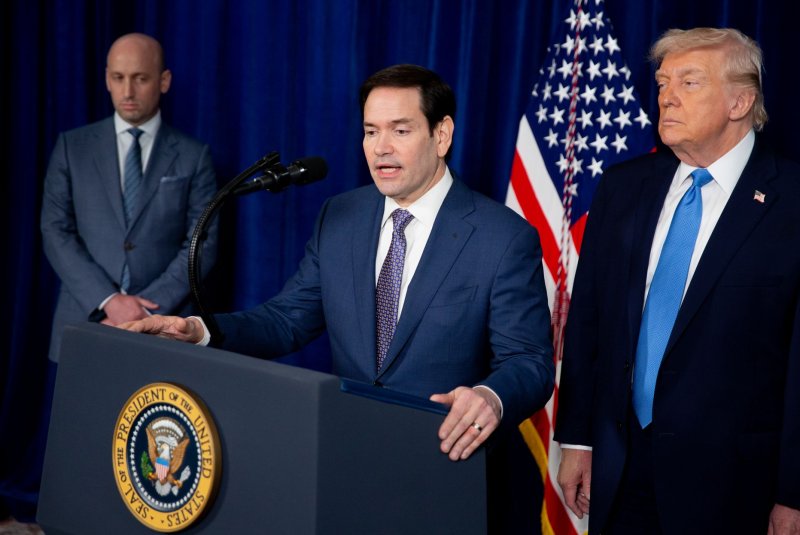
UPDATE: U.S. Secretary of State Marco Rubio has just announced that discussions about elections in Venezuela are “premature” as the U.S. focuses on critical priorities following the recent arrest of Venezuelan President Nicolás Maduro. This announcement comes amidst heightened military presence off the Venezuelan coast, with approximately 15,000 troops stationed on more than a dozen warships in the Caribbean.
In a series of interviews aired on January 4, 2023, Rubio emphasized that the immediate U.S. objectives include revitalizing Venezuela’s struggling oil industry and dismantling ties between the Maduro regime and South American drug trafficking organizations. “We will continue to strike drug boats and detain oil tankers,” Rubio stated during his discussions with ABC, CBS, and NBC.
The Trump administration’s strategy hinges on maintaining a “quarantine” on Venezuelan oil, which Rubio asserts is essential for pressuring the remnants of Maduro’s government to cease cooperation with drug gangs and to end oil sales to U.S. adversaries such as Iran and China. “Our goal is to eliminate Venezuela as a crossroads for our adversaries,” Rubio declared on ABC News‘ “This Week.”
The U.S. military’s offshore presence is not just tactical; it serves as leverage. Trump indicated that a second military strike could be launched should Venezuelan forces react to Maduro’s capture, although military commanders opted against immediate action. Rubio reiterated, “The leverage remains. We expect it to lead to results.” The military armada will also play a crucial role in applying pressure on remaining members of Maduro’s administration.
While the Trump administration recognizes the importance of elections and democracy in Venezuela, Rubio made it clear that current priorities focus on national security and the fight against drug trafficking. “Considering new elections in Venezuela is premature at this point,” he stated during an interview with NBC News‘ “Meet The Press.”
As the situation develops, the U.S. is committed to ensuring that Venezuela does not become a “narcotrafficking paradise” for drugs entering the United States. This urgent focus reflects the broader implications for regional stability and U.S. interests. Maduro, along with his wife and four other government officials, awaits trial in New York City on charges related to drug trafficking.
The U.S. does not require Venezuelan oil due to its status as a net oil exporter, but Rubio questioned why adversaries like Iran, Russia, and China should benefit from Venezuelan resources. “They are not even on this continent,” he asserted, emphasizing the U.S. commitment to maintaining security in the Western Hemisphere.
As tensions rise and the U.S. solidifies its position in the Caribbean, all eyes will be on how this military and diplomatic strategy unfolds in the coming days and weeks. The path ahead will be pivotal not only for Venezuela but also for the geopolitical landscape of the Americas.
























