








































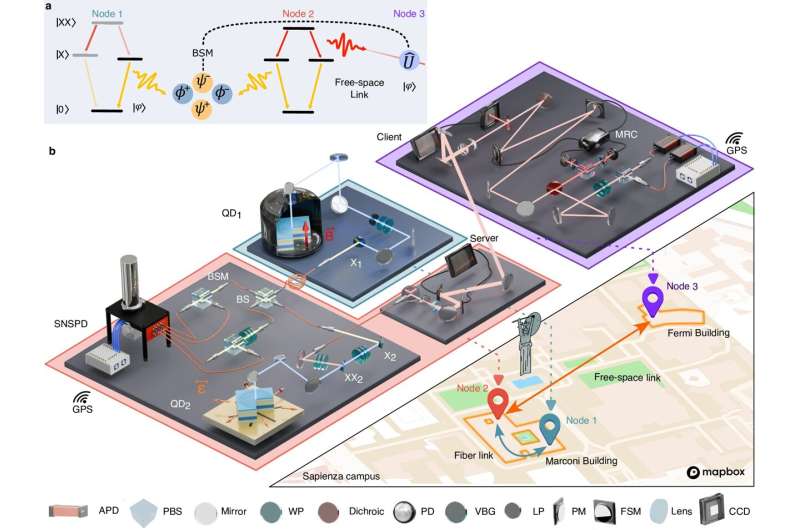
An international research team, including members from Paderborn University, has successfully teleported the polarization state of a single photon emitted from one quantum dot to another quantum dot located 270 meters away. This marks a significant milestone in the development of quantum communication networks, laying the groundwork for a future quantum internet.
The findings were published on December 2, 2025, in the journal Nature Communications. The successful teleportation of photon properties represents a crucial step in the quest for scalable quantum relays, which are essential for effective quantum communication.
Collaboration Fuels Success
Over the past decade, a dedicated team of doctoral and postdoctoral researchers at Paderborn University has focused on optical measurements and data analysis. Professor Klaus Jöns, head of the Hybrid Photonics Quantum Devices research group, collaborated with Professor Rinaldo Trotta from Sapienza University of Rome to achieve this breakthrough.
“The experiment impressively demonstrates that quantum light sources based on semiconductor quantum dots could serve as a key technology for future quantum communication networks,” said Professor Jöns. He emphasized that the successful teleportation between two independent quantum emitters signifies a vital advancement towards practical implementations of a quantum internet.
Entangled systems, composed of multiple quantum particles, enhance quantum communication technologies. They allow for complex information processing and improved data security. Previously, quantum teleportation had only been accomplished using photons from the same emitter. The current achievement with distinct quantum dots represents a significant leap forward in the field.
Technical Innovations Drive Progress
The research results relied on a Europe-wide collaboration. Quantum dots were meticulously developed at Johannes Kepler University Linz, while the nanofabrication of resonators was completed at the University of Würzburg. The teleportation experiments were carried out at Sapienza University of Rome, which utilized a 270-meter free-space optical link connecting two university buildings.
The experiment employed advanced technologies, including GPS-assisted synchronization, ultra-fast single-photon detectors, and stabilization systems to counteract atmospheric turbulence. The fidelity of the achieved teleportation state reached an impressive 82 ± 1%, exceeding the classical limit by over 10 standard deviations.
Looking ahead, the team aims to demonstrate “entanglement swapping” between two quantum dots, marking the first quantum relay with two deterministic sources of entangled photon pairs. Deterministic sources are capable of producing reliable single photons on demand, a significant challenge that has yet to be fully addressed.
Simultaneously, a separate research team from Stuttgart and Saarbrücken achieved a similar result using frequency conversion, further emphasizing the importance of these innovations in European quantum research.
This groundbreaking work in single-photon teleportation not only represents a significant achievement for the involved research teams but also paves the way for future advancements in quantum communication technologies.
For further details, refer to the original study by Alessandro Laneve et al, published in Nature Communications (2025). DOI: 10.1038/s41467-025-65911-9.
























