
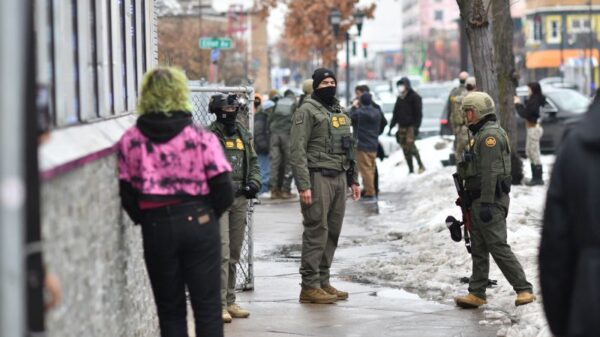




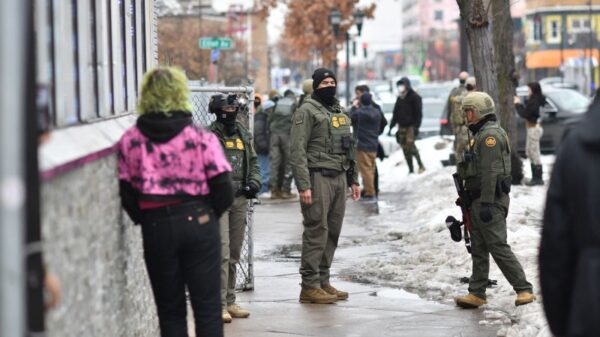

































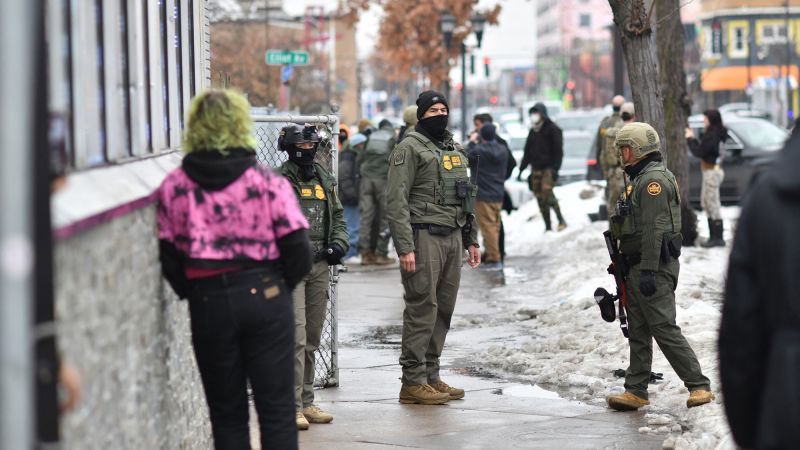
Federal immigration agents have intensified their presence in Minneapolis and St. Paul, Minnesota, causing significant disruption to local businesses. Notably, El Burrito Mercado, a well-established Mexican supermarket and restaurant, has faced a steep decline in sales and foot traffic due to the fear instilled by agents in unmarked vehicles. CEO Melissa Silvia-Diaz expressed her concerns, stating, “ICE is using my business as a hunting ground.” The operation, which began last month, has seen over 2,000 arrests, according to the Department of Homeland Security.
The impact of this crackdown is palpable across the Twin Cities. Business owners report up to 80% drops in sales, and many have temporarily closed their doors. The atmosphere is reminiscent of the early days of the Covid-19 pandemic, with shopping districts nearly empty. The situation escalated tragically last week when Renee Good, a 37-year-old US citizen, was killed by an ICE agent, further unsettling the community. In response, the Twin Cities and the state of Minnesota have initiated legal action against the Trump administration, emphasizing the economic fallout from these operations.
Economic Implications for Local Businesses
Immigrant-owned businesses are the backbone of the local economy, and the recent ICE operations have severely jeopardized their future. El Burrito Mercado, which has served the community for 47 years, has seen a drastic change in its customer base. Traditionally frequented by a predominantly Latino clientele, the supermarket has recently attracted a different demographic, as many of its regular customers have chosen to stay home. Silvia-Diaz shared her anxiety about the sustainability of her business, noting, “This is not sustainable. It makes you wonder — how do we survive this?”
Other establishments are facing similar challenges. Miguel Lopez, owner of Homi, a Mexican restaurant in St. Paul, has shifted to a pickup-only model, citing safety concerns for himself and his employees. “I don’t feel safe either in my house or my business,” Lopez explained.
Target, a major retailer with numerous locations in the metro area, has also become a focal point for ICE activity. Reports indicate that agents have been spotted inside stores, leading to arrests of employees, which have prompted local leaders to call for greater protection for staff.
Long-term Effects on Minnesota’s Economy
The ramifications of these immigration enforcement actions extend beyond individual businesses. Minnesota’s economy relies heavily on immigrant workers and entrepreneurs. The Minnesota Chamber of Commerce has warned that current operations could hinder the region’s long-term economic growth, especially as the state grapples with a declining population and a pressing need for workforce replenishment.
Research indicates that nearly 94% of Minnesota’s net population growth from 2020 to 2024 is attributed to immigration. The chamber reported that the foreign-born labor force has expanded by 41% since 2010, while the growth rate among US-born workers is a mere 4%. Mike Logan, CEO of the Minneapolis Regional Chamber of Commerce, highlighted the broader implications, stating, “My larger fear is this has a much broader impact in terms of attraction and retention of talent to Minnesota.”
As the situation continues to evolve, local businesses and community leaders express hope for a resolution that prioritizes both safety and economic stability. The legal actions taken against the Trump administration could play a crucial role in shaping the future landscape for immigrants and their contributions to Minnesota’s economy. The ongoing turmoil serves as a stark reminder of the intricate relationship between immigration policies and local economic health, with the potential for lasting effects felt across the community.