
































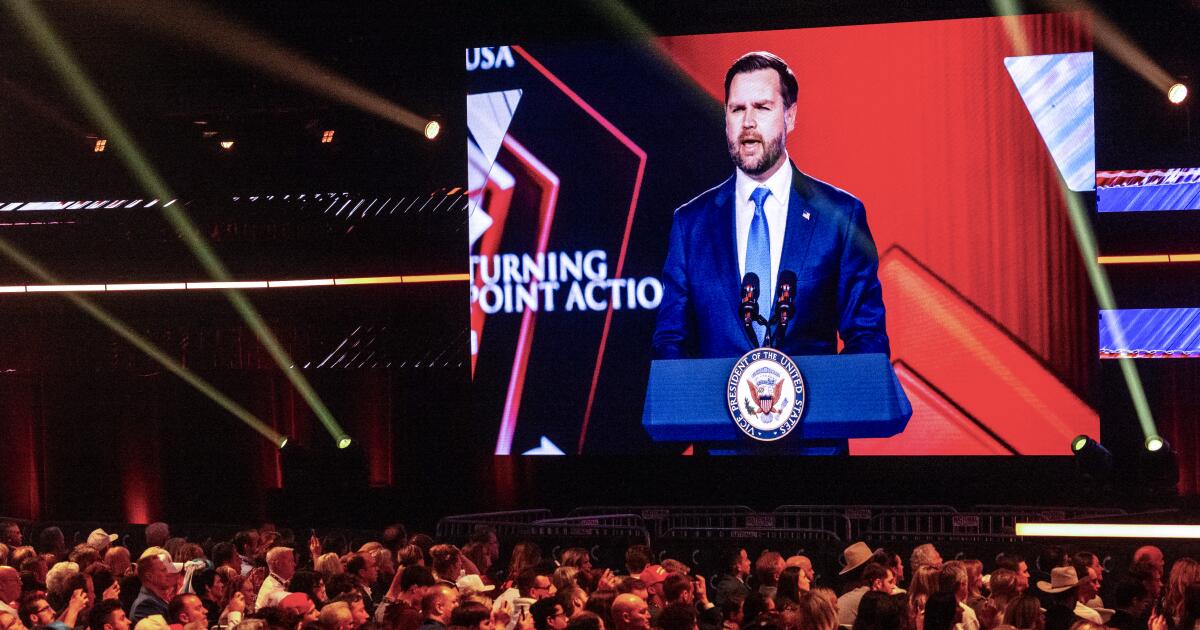
JD Vance, the current Vice President of the United States, is gaining significant support from key Republican factions as the party prepares for the upcoming primaries. Following the tragic death of Charlie Kirk, the founder of Turning Point USA, leaders of the organization are mobilizing to back Vance’s potential presidential campaign. With a focus on building a robust campaign infrastructure across Iowa’s 99 counties, Turning Point USA aims to position Vance, a Midwesterner from Ohio, as a frontrunner in the 2028 Republican primary.
At a recent Turning Point USA conference held in Arizona, Kirk’s widow, Erika Kirk, endorsed Vance, highlighting the organization’s commitment to his candidacy. A straw poll conducted during the conference revealed that 84% of attendees expressed their support for Vance in the upcoming primaries. However, broader public polling paints a more complex picture. A CNN poll from early December indicated that Vance holds a plurality of Republican support at 22%, but 64% of respondents reported having “no one specific in mind,” suggesting a competitive and open race.
While a recent Gallup poll showed that 91% of Republicans approve of Vance’s performance as vice president, only 39% of Americans across party lines view him positively. This discrepancy could pose challenges for Vance should he secure the nomination.
As the political landscape continues to evolve, potential candidates from both sides are expected to evaluate their chances over the next year, with the primary season set to officially begin after the midterm elections in November. Closing out the Turning Point USA conference, Vance emphasized the importance of party unity. He addressed the rising tensions within the party regarding the acceptance of controversial views, stating, “President Trump did not build the greatest coalition in politics by running his supporters through endless, self-defeating purity tests.”
Vance’s remarks aimed to foster inclusivity within the party, but drew criticism from some right-wing factions for perceived tolerance of bigotry. He has faced personal attacks, including racist rhetoric directed at his family by far-right podcaster Nick Fuentes. In response, Vance firmly defended his family, stating, “Let me be clear — anyone who attacks my wife…can eat s—.”
The political future of former President Donald Trump remains uncertain as discussions about a potential third term circulate. Trump, who will be 82 years old at the end of his current term, has acknowledged the constraints of the 22nd Amendment of the Constitution, which limits presidents to two terms. Despite this, some of his supporters continue to advocate for his candidacy in 2028.
Recently, Steve Bannon, a key figure in Trump’s 2016 campaign, expressed skepticism about Vance’s readiness to lead the party, reportedly stating that Vance is “not tough enough.” Meanwhile, Trump’s chief of staff, Susie Wiles, has indicated that Trump understands the constitutional limitations on his candidacy and has discussed this with her on multiple occasions.
Additionally, prominent constitutional law professor Alan Dershowitz has suggested that Trump is likely to forgo another campaign. Following a meeting in the Oval Office, Dershowitz noted that Trump has communicated his reluctance to pursue a third term, stating, “That is my conclusion based on what he has said in public.”
As the Republican Party navigates these complex dynamics, the coming months will be pivotal in shaping the 2028 election landscape, with Vance positioned as a significant contender amidst shifting allegiances and emerging challenges.