








































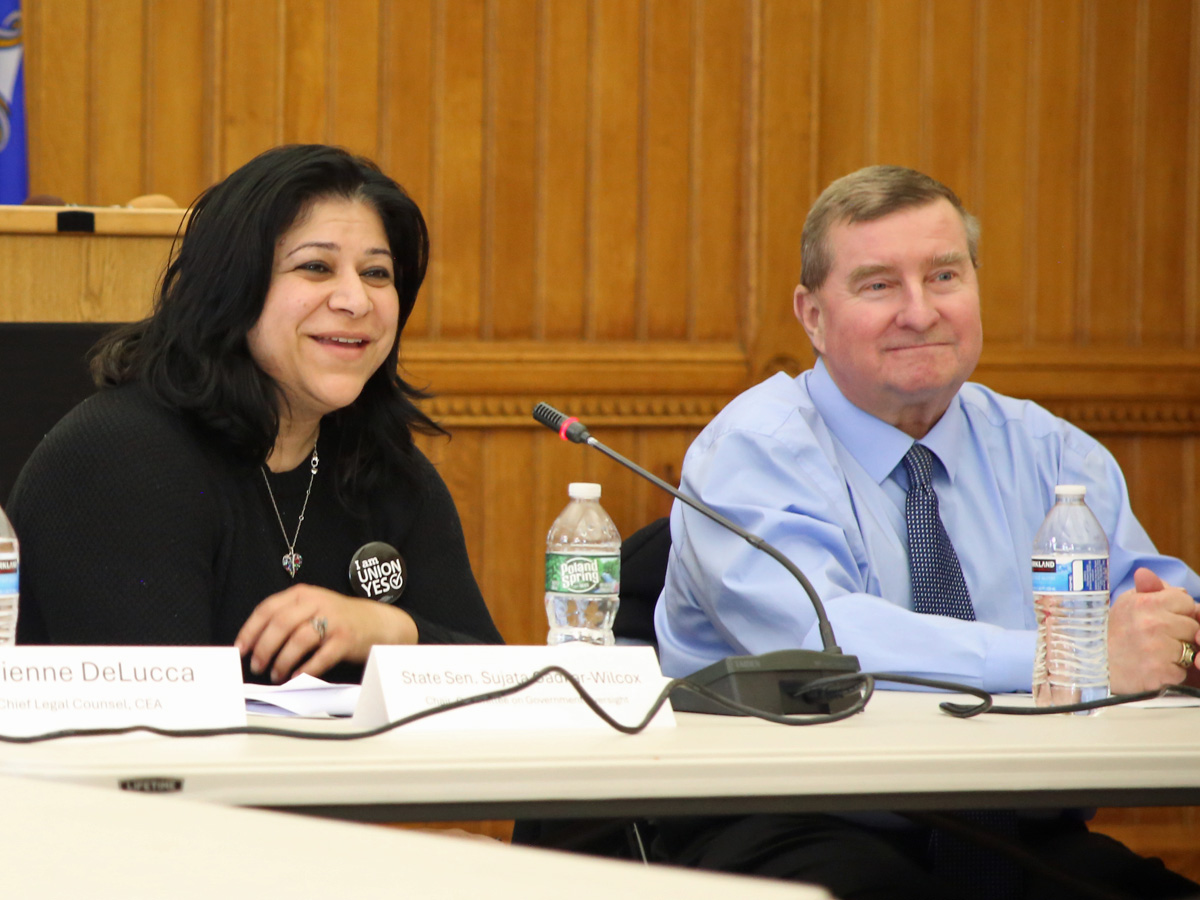
A recent panel discussion at the Connecticut Education Summit addressed the complex issue of teachers’ free speech rights. Held on January 28, 2024, at the State Capitol in Hartford, the event featured state senators and education leaders who examined the challenges educators face when attempting to express their opinions.
State Senator John Kissel, a Republican from Enfield, emphasized that teachers should not have to sacrifice their First Amendment rights in order to maintain their careers. “Expanding teachers’ rights to speak, in certain forums, I would support,” Kissel stated during the discussion. He was joined by Sujata Gadkar-Wilcox, a Democratic senator from Trumbull, who also participated in the dialogue about job security for teachers.
The panel was initiated by Kate Dias, President of the Connecticut Education Association (CEA), who posed a straightforward question regarding the assumption that teachers possess free speech rights. Adrienne DeLucca, CEA general counsel, explained the legal framework surrounding this issue. “Basically, you have to be speaking as a private citizen and not as an employee, and have to talk on a matter of public concern,” she noted.
DeLucca highlighted the ambiguity that arises when a teacher has children enrolled in the same district, complicating the distinction between personal and professional opinions. Furthermore, she pointed out that teachers could face discipline for actions deemed disruptive to the school’s efficient operation. “What does that mean?” she asked. “That means you ticked off one parent.”
Legal counsel for the American Federation of Teachers – CT, James Demetriades, voiced his agreement with DeLucca, stressing the importance of community support for teachers. He noted that educators, who are often among the most educated citizens, have valuable perspectives on issues that affect local families. Demetriades recalled instances where teachers expressed concerns about serious topics, such as the impact of ICE actions on students, yet felt hesitant to speak out due to fears of administrative repercussions.
During the discussion, Gadkar-Wilcox shed light on the challenges posed by social media. Teachers have found their private posts shared publicly by parents, leading to misunderstandings and potential career risks. “There was an incident at a school where there was a threat attributed to a teacher even though the post was shared by a parent,” she explained. She urged for a reevaluation of personal information privacy, advocating for measures to safeguard teachers’ home addresses in light of increased threats.
Kissel recounted his own experiences with protests outside his home, noting the unsettling nature of such incidents. “It’s not often, but it’s a little disconcerting,” he remarked, acknowledging the heightened risks teachers face today compared to previous years.
The panel discussion underscored the pressing need for a clearer understanding of the balance between teachers’ rights and their professional responsibilities, as well as the importance of community backing in protecting educators who wish to voice their opinions. As the conversation about teachers’ rights continues, stakeholders in Connecticut are urged to consider effective policies that will safeguard these essential freedoms while fostering a supportive educational environment.
























