








































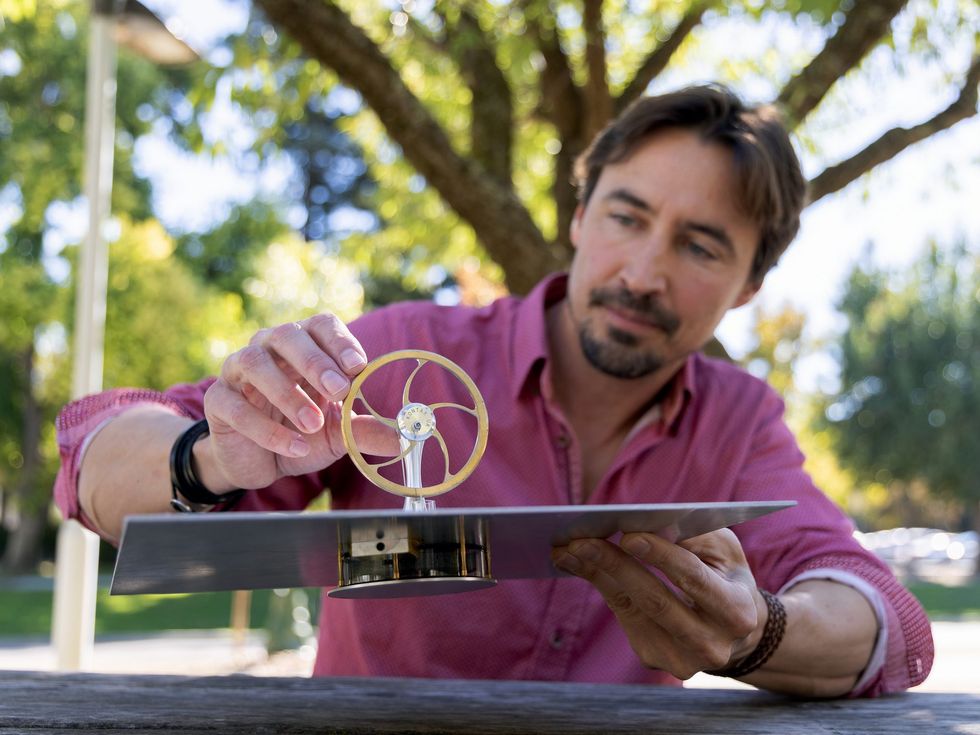
Researchers have developed a groundbreaking device that generates power by absorbing heat from its surroundings and beaming it into space. Unlike traditional solar panels, this innovative technology harnesses ambient heat to create energy, offering potential solutions for energy-efficient ventilation in homes and greenhouses.
In a study led by Jeremy Munday, a professor of electrical and computer engineering at the University of California, Davis, the team explored the concept of thermoradiative devices. These devices operate similarly to solar cells but function in reverse. Instead of capturing sunlight, they emit heat as infrared radiation that escapes into the atmosphere, a process known as radiative cooling. This technology could significantly reduce electricity demand, particularly in regions where air conditioning accounts for nearly 15 percent of energy consumption in buildings.
Historically, radiative cooling technologies relied on rare or expensive materials, limiting their practicality. Munday and his colleagues shifted focus to using Stirling engines, which are simpler mechanically and do not require exotic materials. “They also directly produce mechanical power—which is valuable for applications like air movement or water pumping—without needing intermediate electrical conversion,” Munday explained.
At the core of a Stirling engine is a gas sealed within an airtight chamber. As the gas is heated, it expands, increasing pressure and driving a piston. Unlike internal combustion engines, which require significant temperature differences, Stirling engines can operate efficiently with smaller temperature variances. This new device combines a Stirling engine with a heat-radiating antenna, allowing it to generate power from the ambient heat of its surroundings.
The researchers conducted outdoor experiments over a year, demonstrating that the device could achieve cooling of more than 10 degrees Celsius in most months. This temperature drop translated into the production of over 400 milliwatts of mechanical power per square meter. This power was harnessed to directly operate a fan and was also connected to a small electrical motor to generate current.
Due to its reliance on ambient heat rather than sunlight, the device’s power output is considerably lower than that of solar photovoltaics—approximately two orders of magnitude less. However, Munday emphasized that the aim is not to replace solar energy but to provide an alternative energy source when solar power is unavailable, particularly during nighttime and without the need for batteries or wiring.
The researchers estimated that the device could facilitate a flow of more than 5 cubic feet of air per minute, meeting the minimum air circulation requirements set by the American Society of Heating, Refrigerating and Air-Conditioning Engineers to mitigate health risks in public buildings. Potential applications include enhancing carbon dioxide circulation in greenhouses and improving indoor comfort in residential spaces.
Looking ahead, Munday and his team see significant opportunities for enhancing the device’s efficiency. They propose using hydrogen or helium gas instead of air to reduce internal engine friction. “With more efficient engine designs, we think this approach could enable a new class of passive, around-the-clock power systems that complement solar energy and support resilient, off-grid infrastructure,” Munday stated.
The researchers plan to install these devices in real-world greenhouses as proof-of-concept applications and aim to adapt their design to function efficiently during the day. Their findings were published in the journal Science Advances, marking a significant step forward in the quest for sustainable and efficient energy solutions.
























