







































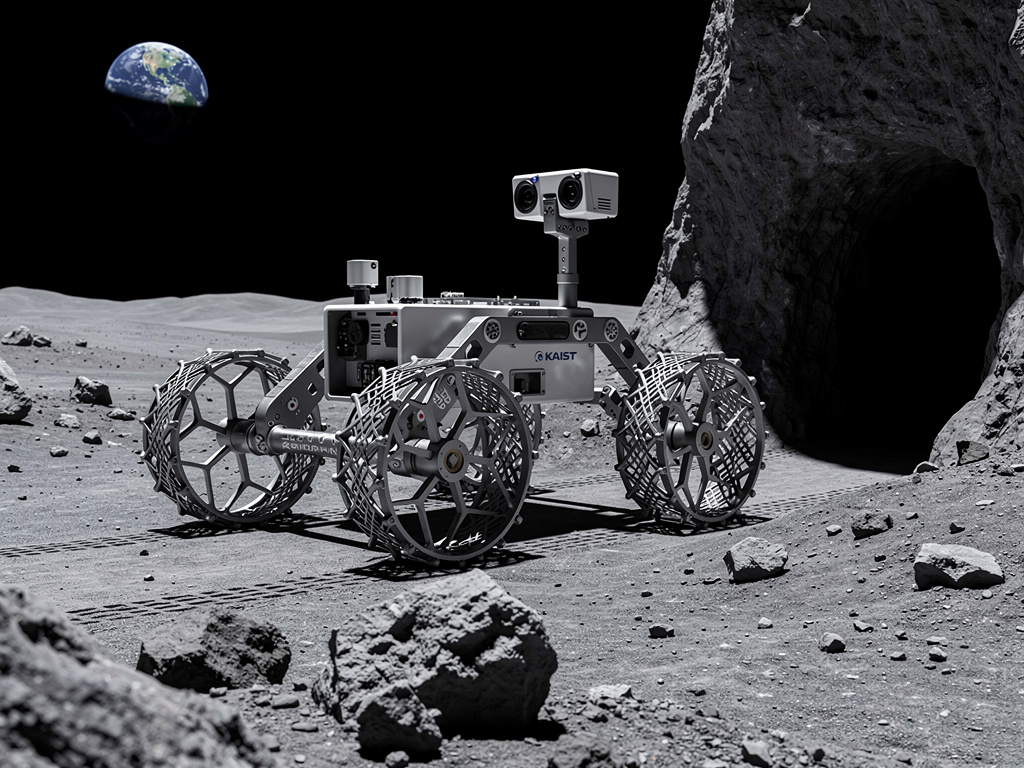
UPDATE: South Korea’s innovative lunar rover with groundbreaking morphing wheels has just been revealed, poised to navigate the moon’s most challenging terrains. Developed by researchers at the Korea Advanced Institute of Science and Technology (KAIST), this compact rover is designed to explore rugged lunar caves that could serve as future human habitats.
This urgent breakthrough comes as countries intensify their lunar missions. The rover features transformative wheels that expand and contract, enhancing its ability to traverse uneven lunar landscapes and navigate narrow passages. These airless wheels, crafted from advanced carbon steel, can absorb shocks and adapt dynamically to harsh conditions, outperforming traditional rover designs.
Researchers at KAIST have conducted extensive tests, including exposure to extreme temperatures and simulated lunar conditions, confirming the rover’s ability to withstand the moon’s hostile environment. The prototype was rigorously tested on Earth, demonstrating its potential for future missions aimed at exploring the moon’s hidden depths.
This development aligns with South Korea’s ambitious space program, following the successful launch of its first lunar orbiter, Danuri, in 2022. Danuri has already provided crucial data and stunning imagery of the moon’s dark regions, marking a significant step in lunar exploration. The rover is set to complement these orbital efforts by conducting ground-level reconnaissance of areas that larger vehicles cannot access.
According to the KAIST team, “The wheel could absorb impacts and navigate uneven terrain while remaining robust under extreme lunar conditions.” This innovative design eliminates air from the wheels, reducing failure points that traditional inflatable wheels face in vacuum environments.
The implications of this technology extend beyond lunar exploration. Industry experts highlight its potential for integration into larger mission frameworks. Plans for a mothership rover deploying smaller units with morphing wheels could revolutionize scouting missions in lunar caves, similar to strategies employed in NASA’s Artemis program.
With South Korea actively participating in international partnerships like the NASA-led Artemis Accords, the country is positioning itself as a key player in global lunar exploration. The KAIST rover could play a pivotal role in upcoming missions, especially alongside China’s Chang’e-8 mission, which aims to investigate lunar resources.
Despite the promising technology, challenges remain. Lunar regolith, the moon’s fine dust, poses significant risks to mechanical systems. However, the woven structure of the KAIST wheels is designed to flex rather than grind, offering a solution to this persistent issue.
The KAIST team is set to conduct vacuum chamber tests to further validate the rover’s capabilities in conditions that closely mimic the lunar environment. These efforts are critical as South Korea aims to launch its first lunar lander by the early 2030s, which may incorporate this innovative wheel technology.
As space enthusiasts and industry insiders discuss the potential of such adaptable designs, the excitement surrounding lunar robots continues to grow. The KAIST rover’s ability to explore caves—natural shelters that could protect future astronauts from radiation—highlights its importance in the broader context of establishing a human presence on the moon.
In conclusion, South Korea’s morphing wheel lunar rover is not just a technological marvel but a significant step towards sustainable exploration of the moon’s hidden terrains. With continued advancements and collaborations, this rover could reshape the future of lunar exploration and pave the way for human habitation on the lunar surface. As nations ramp up their efforts to explore the cosmos, innovations like these will define the next era of space discovery.