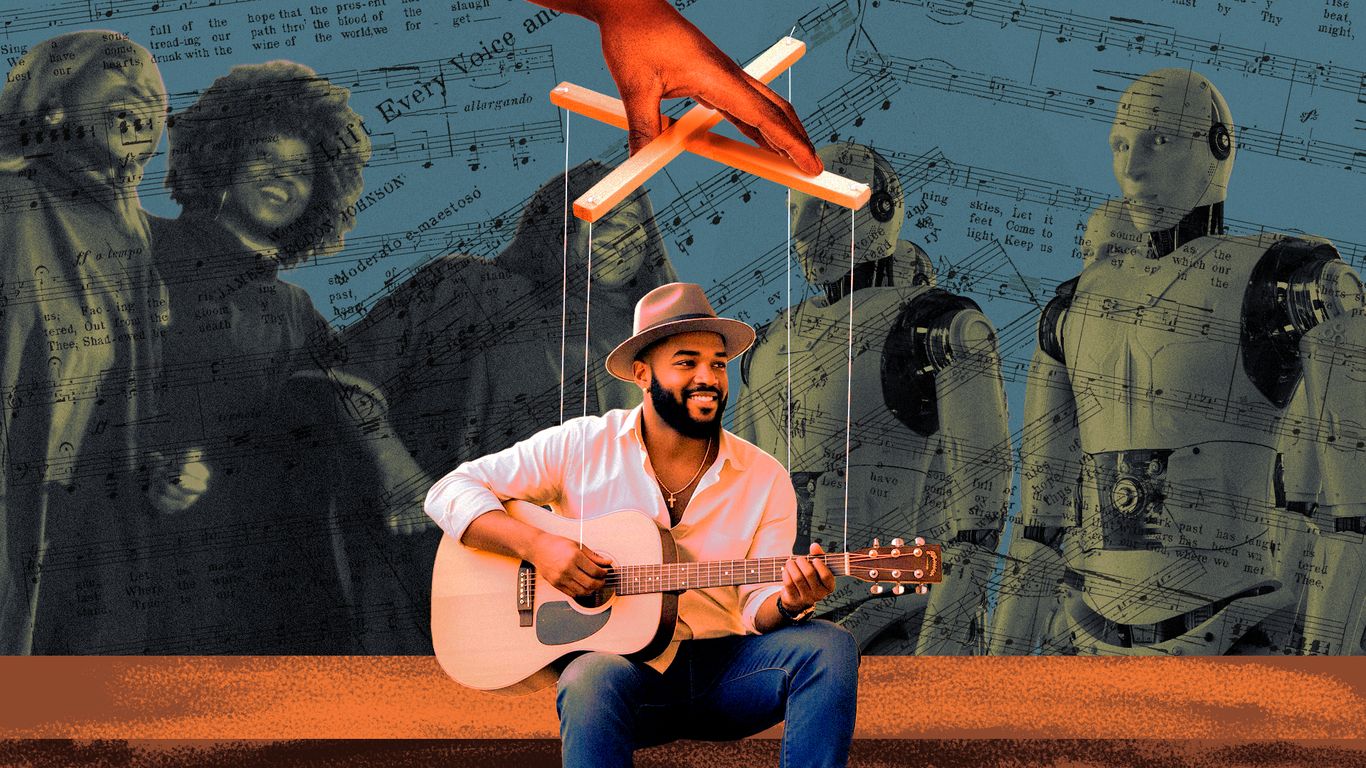
An artificial intelligence-generated gospel singer named Solomon Ray has made headlines by reaching the top of Christian music charts, sparking discussions about authenticity, race, and the future of music. This breakthrough marks a significant moment as Solomon Ray becomes one of the first AI-generated Black Christian artists to gain recognition on major streaming platforms.
In March 2023, Solomon Ray achieved No. 1 status on several music charts, including Billboard‘s gospel digital song sales and the Apple Music Christian song lists. The artist’s popularity has surged, amassing over 7 million streams across various platforms, with his YouTube channel also racking up more than a million views.
The project is the brainchild of Christopher “Topher” Townsend, a Mississippi-based rapper and conservative activist. Townsend, a Black man with a background as an Air Force cryptologic analyst, initiated the Solomon Ray project earlier this year. Utilizing generative AI tools, he crafted the singer’s voice, persona, lyrics, and production elements.
In a statement through Solomon Ray’s Instagram account, Townsend expressed his surprise at the overwhelming response. “I’ve received thousands of messages from listeners who feel seen, comforted, and spiritually lifted by his songs,” he noted. “The impact has far exceeded anything I anticipated, and the numbers reflect that in earnest.” He emphasized his intention to uplift rather than replace traditional gospel music, reinforcing that his creation is a musical project, not a political statement.
The emergence of Solomon Ray coincides with a broader trend in the music industry, where AI-generated songs are making waves across genres. Recent hits in country music, such as Breaking Rust with the song “Walk My Walk” and Cain Walker‘s “Don’t Tread On Me,” have also seen success on the charts, showcasing the growing influence of AI in music production.
Experts are weighing in on the implications of this phenomenon. James Grimmelmann, a professor of digital and information law at Cornell Tech, highlighted the unsettling nature of AI-generated music. “You can have complete virtual performers…deepfake videos, AI voices. It’s unsettling because you can construct an entire artist from scratch,” he explained. Grimmelmann also pointed out potential cultural issues, noting that marginalized groups may be excluded from training data used by AI systems.
Conversely, Rev. Chris Hope, founder of the Boston-based Hope Group, believes that AI should not replace the human element in music. He acknowledged that churches have long incorporated synthesizers and electronic elements but emphasized that AI should not substitute for human stories and experiences. “Black gospel music is rooted in the tradition of testimony from real people,” he stated. “If there’s no authentic witness, then what are you really listening to?”
The discourse surrounding AI music extends to concerns about cultural appropriation. Mia Moody-Ramirez, a journalism professor at Baylor University, cautioned that AI music could commodify Black culture. She described digital blackface as the exploitation of Black identities by non-Black users online, often relying on stereotypes. Without proper documentation, significant amounts of AI-generated content may disappear before society can fully address these issues.
As the music industry evolves with the integration of AI, the case of Solomon Ray serves as a focal point for discussions about authenticity, representation, and the role of technology in creative expression. The future of music may well depend on how artists, listeners, and industry stakeholders navigate these complex and often contentious waters.