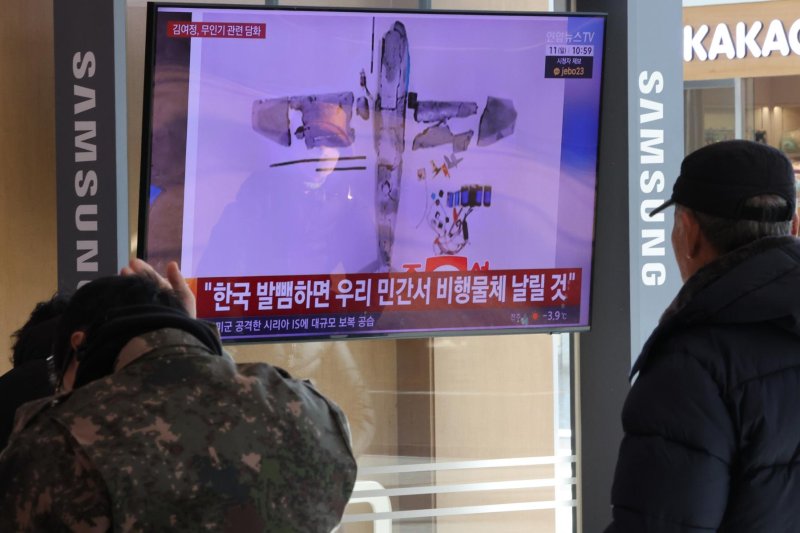
North Korea has accused South Korea of violating its airspace with drone incursions, issuing a stern warning that Seoul should be prepared to “pay a high price” for these alleged provocations. The claims, made on Saturday, focus on incidents from September 2023 and earlier this week, with Pyongyang asserting that South Korean military operations are increasingly hostile.
According to a statement from the General Staff of the Korean People’s Army, reported by the Korean Central News Agency (KCNA), North Korea views South Korea as its “most hostile” enemy. The spokesperson insisted that South Korea continues to engage in provocative actions while simultaneously attempting to initiate dialogue with Pyongyang. “The Republic of Korea (ROK) should be ready to pay a high price for having committed another provocation of infringing on the sovereignty of the DPRK with a drone,” the statement read. Here, DPRK refers to North Korea’s official name, the Democratic People’s Republic of Korea.
On January 4, 2024, North Korean military forces claimed to have captured and tracked an air target moving northward from South Korea’s Ganghwa County, near Incheon. They reported using electronic warfare capabilities to intercept the drone, which subsequently fell in Muksan-ri, close to the border city of Kaesong. North Korea also recalled a separate incident from September 27, 2023, where a drone allegedly launched from Paju in South Korea was downed as it returned from what the North described as an incursion into its airspace.
The North asserted that the downed drone was equipped with surveillance technology capable of recording significant locations within its territory while covering a distance of 156 kilometers for over three hours. Accompanying this claim, North Korea released images of debris, devices, and suspected footage captured by the drones. The North Korean statement further likened South Korea to “Kiev’s lunatics,” drawing a parallel with Ukraine amid its ongoing conflict with Russia.
In response, South Korea’s Defense Minister, Ahn Gyu-back, firmly rejected North Korea’s assertions, calling them “absolutely not true.” He noted that the drones depicted in the images released by North Korea do not match any models used by the South Korean military. The South Korean defense ministry has initiated a “thorough” investigation into the matter, with relevant agencies currently verifying the facts.
Experts have expressed skepticism regarding North Korea’s claims, suggesting that the drones displayed do not appear to be military-grade vehicles. Analysts posited that the drones may consist of low-cost components unsuitable for military operations.
The backdrop to these accusations includes tensions from October 2023, when North Korea reported that South Korean drones carrying anti-North propaganda were detected over Pyongyang. North Korea threatened reprisals should such flights continue, while suspicions lingered that South Korean military actions during the previous administration of President Yoon Suk Yeol aimed to provoke the North as part of a broader strategy.
As North Korean leader **Kim Jong-un** has recently characterized inter-Korean relations as those between “two states hostile to each other,” the rhetoric from the North reflects a hardening stance. Since President **Lee Jae Myung** took office in June 2023, there has been an effort to improve relations with North Korea and revive dialogue. However, experts believe that North Korea is solidifying its confrontational policy ahead of an important party congress scheduled for January or February 2024.
Analysts expect that this congress will establish a new five-year strategy encompassing diplomatic, economic, and military objectives, potentially enshrining the “two hostile states” framework into official policy. **Hong Min**, a senior researcher at the Korea Institute for National Unification, indicated that the upcoming congress could lead to constitutional revisions to formalize this stance.
The situation remains tense, with both nations navigating a complex landscape of diplomacy and military posturing.