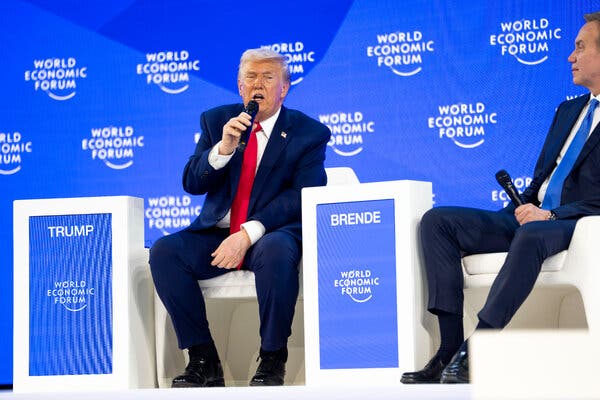
President Donald Trump has once again stirred tensions in international trade, threatening European nations with punitive measures unless they comply with his controversial demand regarding Greenland. This bold assertion has raised the prospect of a trans-Atlantic trade conflict, leading to significant market volatility and urgent discussions among European leaders.
During a four-day period, Trump’s rhetoric prompted stock markets to decline sharply as European officials convened emergency meetings and attempted to contact the U.S. president to address the escalating situation. The urgency was compounded by the suspension of a trade agreement that had been meticulously negotiated just months prior. In a sudden turn, Trump claimed to have established “the framework of a future deal” concerning Greenland and the Arctic, although details of this agreement remain sparse. He further announced that the planned tariffs on eight European countries, set to take effect on February 1, would no longer be necessary. This announcement led to a rebound in stock market performance.
While Trump’s abrupt retreat from the brink of a trade war may have eased immediate tensions, it has left a trail of uncertainty that continues to destabilize global trade relations. The chaotic nature of his approach raises questions about the effectiveness and reliability of U.S. trade policies, particularly as nations begin to reassess their partnerships with the United States.
Trump’s tactics have seemingly pushed countries closer to one another, and notably towards China, as they seek stability in their trading arrangements. Entering the second year of his second term, Trump has had numerous opportunities to reshape the international trading landscape. Yet, his persistent inclination to disrupt existing agreements suggests a willingness to prioritize immediate political gain over long-term trade stability.
Global businesses and foreign leaders had anticipated that 2023 would mark the end of tariff-related uncertainty. Although the prospect of increased tariffs looms, there was hope that a series of finalized trade agreements would provide a framework for predictability in international commerce. Instead, Trump’s recent actions indicate a renewed eagerness to inject chaos into the global trading system, further complicating the landscape for businesses reliant on stable international relations.
As this situation develops, the implications of Trump’s unpredictability extend beyond immediate economic impacts, potentially reshaping the future of international trade dynamics. The ongoing uncertainty surrounding U.S. trade policy continues to challenge the very foundations of established trade agreements, leaving many to ponder the long-term consequences of Trump’s approach on the global stage.