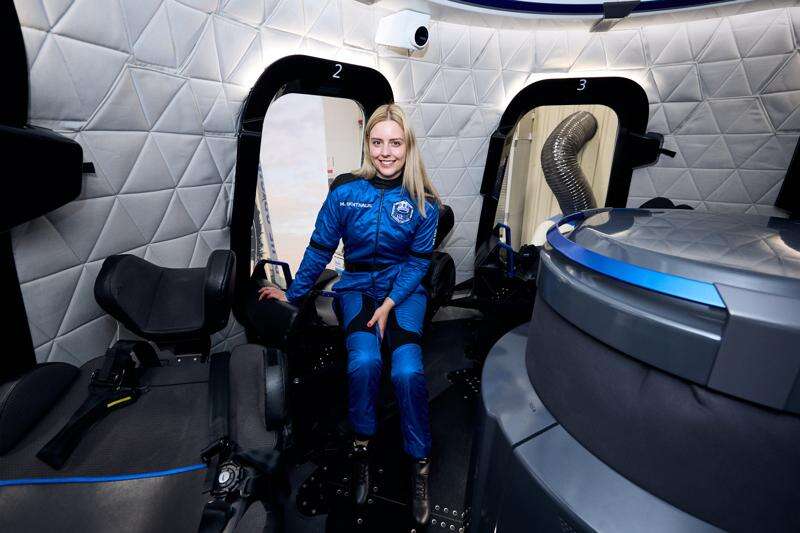
UPDATE: In a groundbreaking moment for space travel, Michaela Benthaus, a paraplegic engineer from Germany, launched into space on July 15, 2023, becoming the first wheelchair user to achieve this feat. The historic flight, organized by Blue Origin, took off from West Texas and lasted 10 minutes, allowing Benthaus to experience weightlessness while leaving her wheelchair behind.
This monumental journey marks a significant stride towards inclusivity in space exploration. Benthaus, who was severely injured in a mountain bike accident seven years ago, had her dreams of space travel reignited when retired SpaceX executive Hans Koenigsmann approached her about the opportunity. “I never really thought that going on a spaceflight would be a real option for me,” she stated in a pre-flight interview. Yet, she seized the chance, making history alongside five other passengers.
The New Shepard capsule, designed with accessibility in mind, required only minor modifications to accommodate Benthaus. Blue Origin engineer Jake Mills confirmed that the capsule was engineered to be more inclusive than traditional spacecraft. A patient transfer board and a carpet for her return to the ground ensured a smooth transition back to her wheelchair after landing.
“This flight is not just about me; it’s about opening doors for others with disabilities,” Benthaus emphasized. Her aspirations extend beyond space travel; she aims to enhance accessibility on Earth as well.
Among the passengers were business executives and a computer scientist, raising Blue Origin’s tally of space travelers to 86. The flight is a private mission with no involvement from the European Space Agency, though its recent clearance of astronaut John McFall, an amputee, for a future International Space Station mission highlights the growing recognition of individuals with disabilities in space exploration.
Benthaus’s journey is a historic leap towards inclusivity, demonstrating that space is no longer the exclusive domain of the able-bodied. The flight’s success could pave the way for future accessibility innovations in space travel, inspiring others to pursue their dreams, regardless of physical limitations.
As this story unfolds, the implications for both space exploration and disabled representation are profound. Benthaus hopes her achievement will inspire change, stating, “I hope I’m only the start.”
The world watches closely as space travel becomes increasingly accessible, and Benthaus’s flight may just be the catalyst for a broader movement toward inclusivity in the cosmos.