



























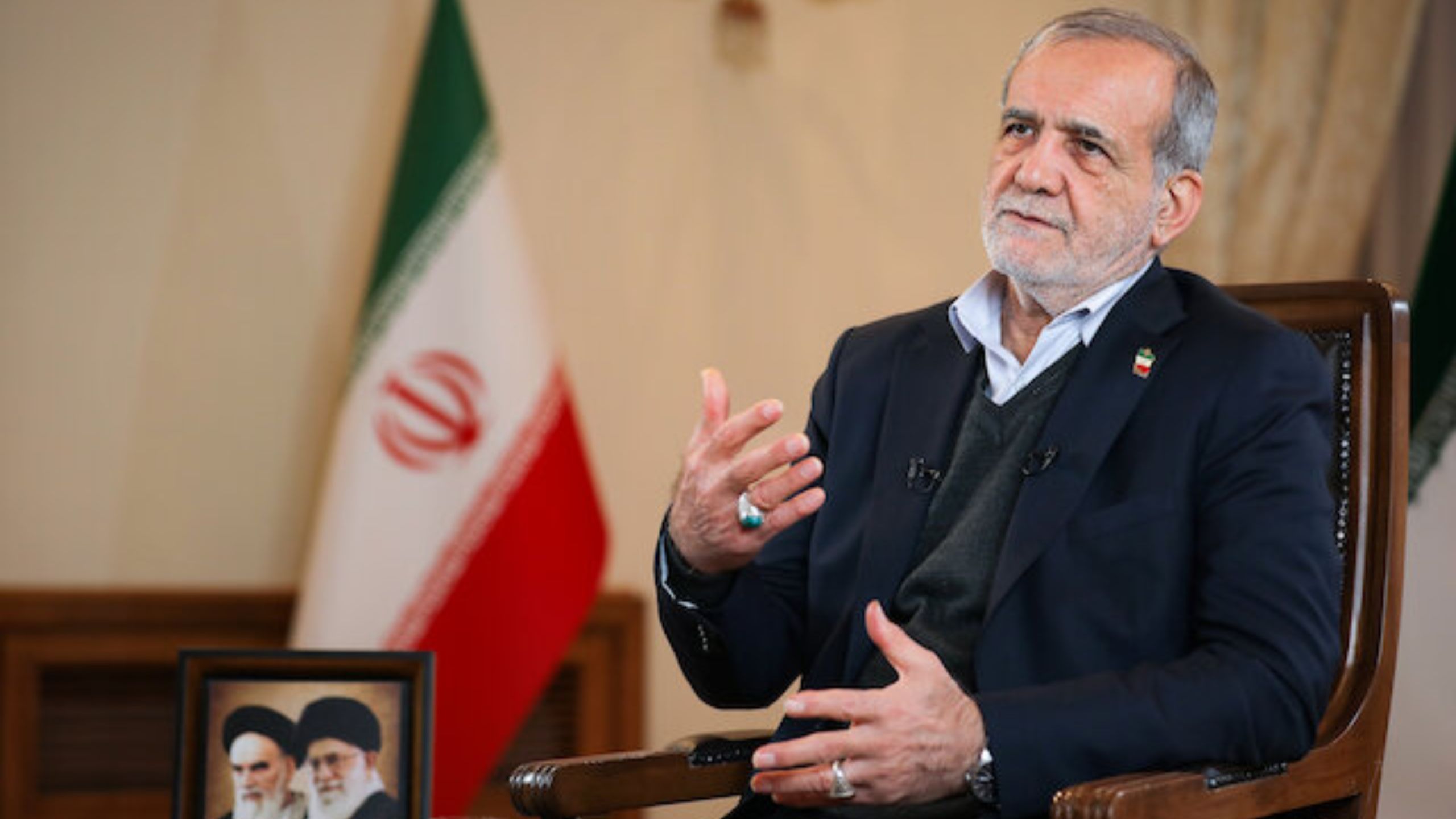
BREAKING: Iran has officially declared a state of ‘total war’ against the United States, Israel, and European nations, escalating tensions that could reshape global security dynamics. In a striking interview published on December 27, 2025, Iranian President Masoud Pezeshkian articulated Tehran’s belief that Western powers are intent on destabilizing Iran through various means, including economic sanctions and diplomatic isolation.
Pezeshkian’s declaration is among the most explicit characterizations of Iran’s relations with the West in decades, stating, “In my opinion, we are at total war with the United States, Israel, and Europe; they want to bring our country to its knees.” This stark admission, featured on the official website of Iran’s Supreme Leader Ayatollah Ali Khamenei, underscores the Iranian government’s urgent messaging in light of recent hostilities.
The backdrop to this declaration includes a deadly 12-day conflict in June 2025, which saw direct confrontations between Iranian and Israeli forces, resulting in over 1,000 deaths, including senior military officials and nuclear scientists. Iranian missile strikes during this period claimed at least 28 lives in Israel. Following these events, the U.S. launched strikes on three Iranian nuclear sites, a move described by Washington as essential for neutralizing potential nuclear threats.
Pezeshkian’s comments come just ahead of a scheduled meeting between U.S. President Donald Trump and Israeli Prime Minister Benjamin Netanyahu in Washington, where Iran will be a central topic of discussion. The declaration signals a significant shift in the rhetoric surrounding Iran’s foreign policy and its self-perception as a target of Western aggression.
Tehran’s ongoing nuclear ambitions have further complicated the situation. In September 2025, France, Britain, and Germany reinstated UN sanctions against Iran, a decision condemned by Iranian officials as an act of aggression. Iran maintains that its nuclear program is purely for civilian use, a claim met with skepticism by Western powers.
The implications of Pezeshkian’s statements extend beyond international relations; they reflect internal pressures as Iran grapples with economic instability, high inflation, and a depreciating rial. As the Iranian government navigates these challenges, Pezeshkian has proposed a 20-point economic plan aimed at stabilizing the economy and supporting lower-income families, although details on its implementation remain sparse.
Internationally, this characterization of ‘total war’ has sparked alarm. Western capitals are closely monitoring the situation, interpreting Iran’s rhetoric in the context of recent hostilities and regional proxy conflicts. The U.S. insists that negotiations regarding Iran’s nuclear program could still be possible but under stringent conditions, including limitations on uranium enrichment—a stance Tehran views as an infringement on its sovereignty.
As Prime Minister Netanyahu prepares to discuss measures to counter Iran’s regional influence with President Trump, the sentiment in Israel is one of heightened urgency. The complexities of Iran’s relationships with non-state actors like Hamas and Hezbollah also factor into Western strategic calculations, further complicating the security landscape.
The world watches as tensions rise, with Pezeshkian’s declaration marking a critical moment in Iran’s ongoing struggle against perceived external threats. As developments unfold, the potential for escalation looms large, leaving many to wonder what the next steps will be in this fraught geopolitical landscape.