




































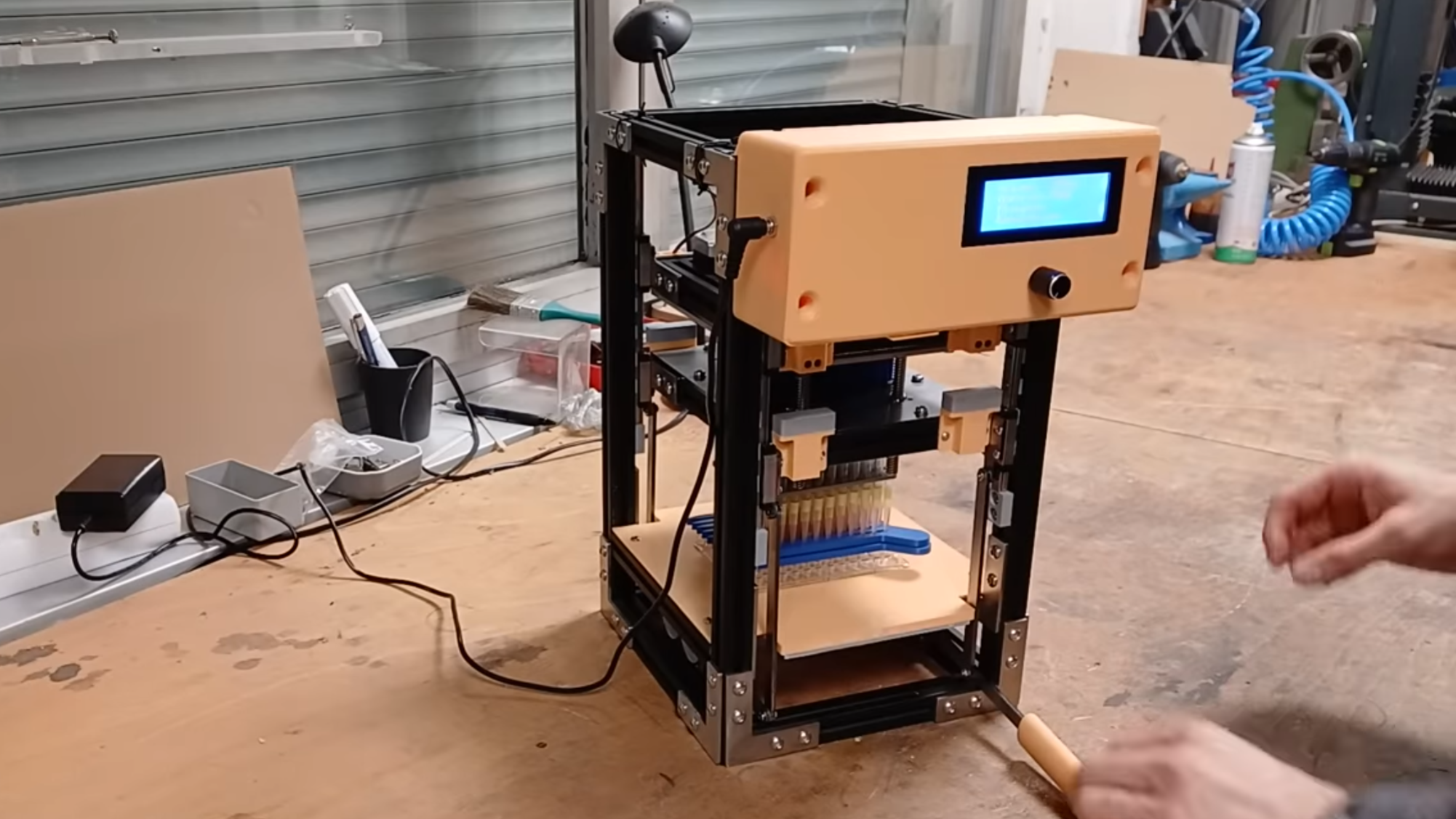
The cost of drug development often stems from the extensive experimentation required, with the design of a single new drug necessitating the synthesis and testing of hundreds or thousands of compounds. To tackle this challenge, a new approach to experimentation is emerging. Triggy, an inventor, has developed a 96-channel multi-pipette that significantly reduces costs, allowing for parallel experimentation at a fraction of the professional price.
Traditional multi-channel pipettes can be prohibitively expensive, often retailing for as much as $18,000. In contrast, Triggy constructed his own device for approximately $300. This innovative pipette features an eight-by-twelve grid of syringes, allowing it to collect and dispense liquids into multiple vessels simultaneously. The syringes are secured by a plate, while their plungers are mounted to another plate activated by four stepper motors.
Design and Functionality of the Multi-Pipette
To accommodate the use of multi-well plates, the syringe mechanism must be able to move vertically. Triggy achieved this by mounting the lower plate to a series of parallel levers and gears. By manually lifting the lever, he can raise the syringes to insert or remove a multi-well plate as needed.
The entire structure is enclosed in an aluminum extrusion frame, with heat-shrink tubing enabling pipette tips to fit on the syringes. While Triggy did not have a sophisticated method to verify the accuracy of the multi-pipette, initial tests yielded encouraging results. He demonstrated its capabilities by 3D-printing two plates with parallel channels, filling them with varying concentrations of watercolors. When the multi-pipette was used to combine the colors from different channels, it produced a smooth gradient across the wells.
This device allows researchers to test up to 96 small variations of a single experiment simultaneously, enhancing efficiency in the laboratory. Despite the advantages of Triggy’s invention, it is important to note that this machine is intended for home experimentation. The precision and certifications required for medical development remain significant hurdles, meaning the device would need extensive testing before being deemed reliable for critical applications.
The Bigger Picture in Drug Development
The high costs associated with drug development can be attributed to several factors, one of which is the need for extensive experimentation. Triggy’s multi-channel pipette offers a more accessible tool for researchers and hobbyists alike, potentially expanding the scope of experimentation in both academic and home settings.
The innovations in miniaturization and automation have made large-scale biology experiments increasingly feasible, leading to a growing trend in DIY lab equipment. While Triggy’s multi-pipette is an impressive feat of engineering, it serves as a reminder of the balance between affordability and the rigorous standards required in professional scientific research.
This development highlights the potential for individuals to contribute to scientific experimentation, albeit with the understanding that any device used for critical research must undergo thorough evaluation. As the landscape of drug development continues to evolve, innovations like Triggy’s multi-pipette may play a significant role in shaping the future of experimentation.