







































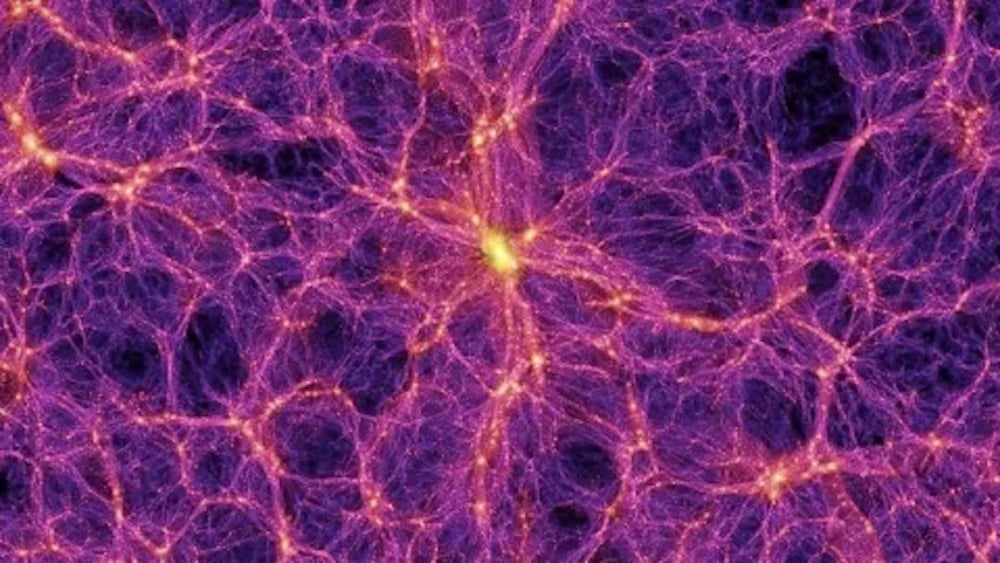
Astronomers have made a groundbreaking discovery of a colossal cosmic structure spinning in the universe. This structure, which spans approximately 50 million light years, consists of an intricate network of galaxies and dark matter, known as cosmic filaments. These filaments serve as a framework for smaller structures, influencing the evolution of galaxies and the distribution of matter across vast distances.
Led by the University of Oxford, an international team of researchers identified a remarkable configuration of 14 hydrogen-rich galaxies arranged in an exceptionally thin line measuring only 5.5 million light years in length and 117,000 light years in width. This string of galaxies is embedded within the larger cosmic filament, which contains over 280 galaxies.
Revealing the Structure’s Motion
What sets this discovery apart is not just its size, but the motion of the galaxies within. The researchers found that many of these galaxies are rotating in the same direction as the filament itself. Analysis of their movement indicates that the entire structure is also undergoing rotation. The team observed opposite movements of galaxies on either side of the filament’s central spine, which is a clear indication of its spinning nature.
By employing models of filament dynamics, the researchers calculated a rotation velocity of 110 kilometres per second and estimated the radius of the filament’s dense core at approximately 163,000 light years. This dual motion—individual galaxies spinning while the entire structure rotates—offers valuable insights into how galaxies gain their angular momentum. Current theories suggest that galaxies typically acquire their spin through interactions with surrounding structures. This discovery indicates that large-scale rotation may influence galaxy spins more significantly and for longer durations than previously thought.
Insights into Cosmic Evolution
The filament appears to be in an early stage of evolution. The abundance of gas-rich galaxies and their low internal motion, referred to as “dynamically cold,” suggest it has remained relatively undisturbed since its formation. These hydrogen-rich galaxies are essential for understanding gas flow along cosmic filaments. Atomic hydrogen serves as the raw fuel for star formation, and its behavior can reveal how material is transferred through these cosmic highways into galaxies.
The findings stem from a collaborative effort that combined data from South Africa’s MeerKAT Radio Telescope with optical observations from various surveys mapping the Cosmic Web. This multi-wavelength approach successfully unveiled the coherent spin alignment of galaxies alongside the overall rotation of the structure, showcasing the effectiveness of integrating different telescopes to reveal phenomena that might otherwise go unnoticed.
In conclusion, this extraordinary discovery of a spinning cosmic structure not only enhances our understanding of galaxy formation and evolution but also illustrates the potential of collaborative astronomical research. As scientists continue to unravel the complexities of the universe, such insights will likely reshape our knowledge of cosmic dynamics and the intricate web of galaxies that populate it.