






































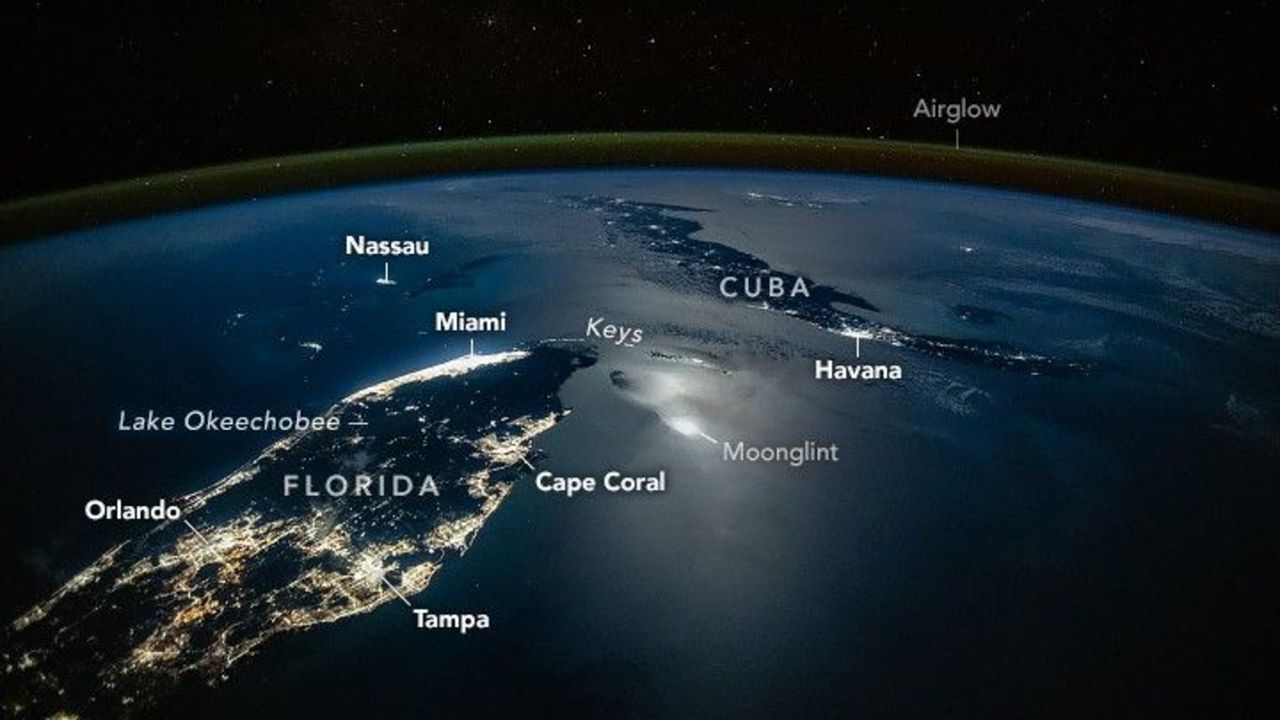
An astronaut aboard the International Space Station (ISS) captured a stunning nighttime photograph of Earth on March 19, 2025, at 02:23 AM Eastern Time. The image showcases the shimmering moonlight reflecting off dark ocean waters, highlighting the Florida Peninsula, parts of the Caribbean, and Central America. The photograph reveals vibrant clusters of city lights that trace the outlines of major urban areas, including the bright corridor connecting Miami and Fort Lauderdale on Florida’s southeastern coast, the Tampa–St. Petersburg region on the Gulf Coast, and the Orlando metropolitan area situated centrally on the peninsula.
The illumination also captures smaller population centers, such as the Florida Keys, Nassau in the Bahamas, and various cities across Cuba, including Havana. This nighttime imagery provides a unique perspective on human settlement patterns that are often obscured during daylight hours.
Understanding Moonglint and Airglow
What makes this image particularly remarkable is the phenomenon known as moonglint. This occurs when moonlight reflects off the ocean’s surface at a specific angle, allowing the light to reach the observer—in this case, a crewmember aboard the ISS, orbiting approximately 248 miles (400 kilometers) above Earth. The moon was in a waning phase, approximately 78% illuminated, which facilitated a concentrated reflection over the sea, especially noticeable near the Florida Keys and Cuba.
The photograph, taken with a Nikon Z9 digital camera equipped with a 28-millimeter lens, offers a wide field of view similar to that of the human eye. This perspective beautifully captures the curvature of the planet, enhanced by a faint green layer of airglow along the horizon, a subtle reminder of Earth’s atmosphere glowing softly against the vastness of space.
Scientific Significance of Nighttime Imagery
Nighttime images of Earth are not merely aesthetic; they hold significant scientific value. They provide crucial insights into urban growth, energy consumption, and light pollution. Researchers utilize this data to examine the intersection of human activity and natural environments, offering a clearer understanding of how populations expand and how infrastructure develops.
The appearance of moonglint is particularly valuable for oceanographic studies. Reflections of moonlight can assist scientists in analyzing sea-surface conditions, such as roughness and wave patterns, even at night. When integrated with other data sources, such observations enhance our understanding of ocean–atmosphere interactions and refine models used in climate and environmental research.
As interest in such phenomena grows, the collaborative efforts of organizations like NASA continue to shed light on both the beauty and complexity of our planet. The ISS remains a vital platform for capturing these unique perspectives, contributing to our overall understanding of Earth and its intricate systems.
For those curious about airglow and the ongoing research conducted aboard the ISS, more information can be accessed through NASA resources, offering an in-depth look at these fascinating scientific endeavors.