








































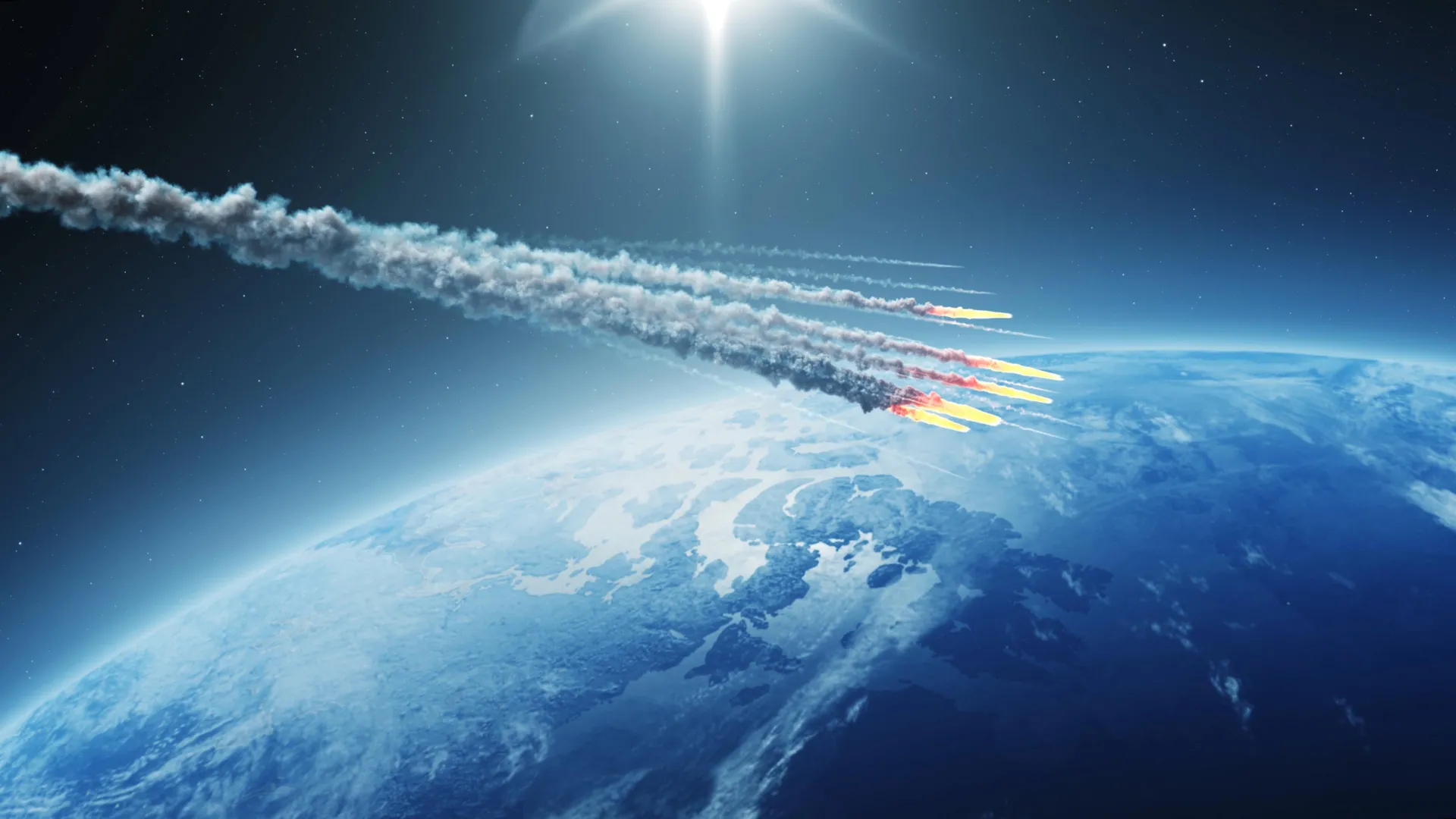
Recent research from the University of California – Santa Barbara has revealed that Earth may have experienced far more “invisible” explosions from space than previously understood. These cosmic events, known as “touchdown airbursts,” involve comets or asteroids detonating above the Earth’s surface, generating intense heat and pressure without leaving visible craters. This makes them challenging to detect, raising concerns about their potential destructive power.
According to James Kennett, Emeritus Professor of Earth Science, these airbursts could be significantly more frequent and impactful than the well-known, crater-forming impacts associated with historical mass extinctions. Kennett stated, “Touchdown events can cause extreme damage through very high temperatures and pressures,” emphasizing that the lack of traditional craters does not diminish their threat.
The research, which includes four newly published studies, offers evidence of multiple historical airburst events occurring at different times. These incidents involve an incoming cosmic object that explodes in the atmosphere, releasing shockwaves and heat that affect Earth’s surface. Evidence of these events has been collected from diverse locations, including deep ocean sediments in the North Atlantic and the remnants of an ancient desert city.
Significant Findings Related to the Younger Dryas
One noteworthy study published in the journal PLOS One details the first discovery of impact markers associated with the Younger Dryas Impact Hypothesis (YDIH) within marine sediments. Researchers recovered material from deep-sea cores in Baffin Bay, located off Greenland’s western coast. Kennett remarked, “Baffin Bay is very significant because it’s the first time we’ve found evidence for the Younger Dryas cosmic impact event in the marine record.”
The Younger Dryas, which occurred approximately 12,800 years ago, is believed to have been triggered by fragments of a comet that exploded over Earth, initiating a sudden global cooling period. This era coincided with the extinction of numerous large animals and significant shifts in human populations and cultures. The explosions likely ignited widespread fires, leaving behind a characteristic carbon-rich layer known as a “black mat,” which has been found primarily across the Northern Hemisphere.
Recent findings indicate that the materials associated with these cosmic events can be preserved in marine sediments at depths of around 2,000 meters. While these elements do not directly measure the strength of the explosions, they provide insight into the scale and climatic implications of the events.
Exploring the Evidence for Airbursts
The challenges of detecting cosmic impacts stem from the varied nature of these events. Unlike large impacts that typically leave behind craters—such as the famous Chicxulub crater linked to the extinction of dinosaurs—touchdown airbursts often do not alter the landscape significantly. Kennett pointed out that there has been no evidence for the Younger Dryas boundary event corresponding to any known crater, complicating the search for physical evidence.
Researchers are investigating a shallow seasonal lake near Perkins, Louisiana, which may represent the first known crater linked to the Younger Dryas Boundary. The research team revisited a suggestion made in 1938 regarding the lake’s circular shape and raised rim. Detailed sediment analysis began in 2006, and between then and 2024, researchers identified meltglass, spherules, and shocked quartz. Radiocarbon dating indicates these materials correspond to the Younger Dryas period, though the team acknowledges the need for further investigation to confirm the hypothesis.
Additional studies focused on the Tunguska explosion in 1908 and the ancient city of Tall el-Hammam, believed to have been destroyed by a similar event around 3,600 years ago. The researchers argue that airbursts can produce a range of fracture patterns in shocked quartz, contrary to traditional associations with large impacts. At the Tunguska site, they found quartz with clear planar fractures, alongside tiny impact-formed spheres and melted materials.
The investigation into Tall el-Hammam confirmed the presence of shocked quartz showing diverse crack patterns, suggesting intense pressures and complex blast dynamics.
Kennett concluded that these studies collectively indicate that cosmic impacts, particularly touchdown airbursts, may occur more frequently and with greater destructive potential than previously believed. “They’re far more common, but also possess much more destructive potential than the more localized, classic crater-forming asteroidal impacts,” he noted. The implications of these findings underscore the need for further research into cosmic threats that could impact humanity.
























