







































An international team of archaeologists has made a groundbreaking discovery in the Nefud Desert of Saudi Arabia, unveiling a collection of rock art that dates back over 12,000 years. Their findings, published in the journal Nature Communications, challenge previous assumptions about early human settlement in the Arabian Peninsula.
The research team identified more than 170 engravings on cliffs near the southern edge of the Nefud Desert, specifically in three previously unexplored areas: Jebel Arnaan, Jebel Mleiha, and Jebel Misma. This collection not only establishes an earlier timeline for figurative rock art but also suggests the existence of extensive cultural networks connecting these early communities to the Levant, located approximately 400 kilometers to the north.
Finding the Engravings
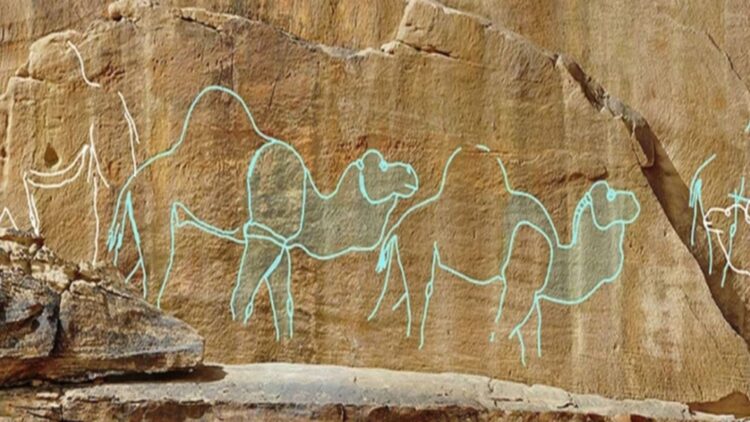
The journey to discover these ancient artworks began in May 2023, when researchers set out to explore a region not previously included in UNESCO’s World Heritage list. Erosion and time had obscured many examples of rock art, but the team successfully located over 60 rock art panels featuring a total of 130 engravings. The images depict large, life-sized animals, including camels, goats, and gazelles.
Maria Guagnin, one of the lead researchers, described a particularly striking panel featuring two large camels. One appeared to be in motion, while the other seemed to be walking. Alongside these engravings, the team uncovered artifacts typical of the era, such as small arrowheads and stone beads.
By employing luminescence dating, the researchers determined that the sediment where an engraving tool was found dates back to 12,000 years ago. This method measures the last time sediment was exposed to light, providing a reliable timeline for the artifacts.
Significance of the Discovery
The implications of this discovery extend beyond the art itself. The engravings indicate a long-distance movement of people who shared common tools and jewelry with communities in the Levant. This connection highlights the cultural interactions that existed among ancient populations, even across significant geographical distances.
The team also revealed that the newly explored site had been a seasonal lake 15,000 years ago, a stark contrast to its current arid state. This transformation aligns with the return of surface water to Arabia after a prolonged period of extreme aridity. Such findings alter the understanding of when humans could have established settlements in this region, suggesting that the climate played a crucial role in shaping early human activity.
This research not only enriches our understanding of prehistoric life in the Arabian Peninsula but also underscores the importance of cultural exchange and adaptation in response to environmental changes. As more discoveries unfold, the narrative of human history in this area continues to evolve, revealing the depth and complexity of our ancestors’ lives.