





































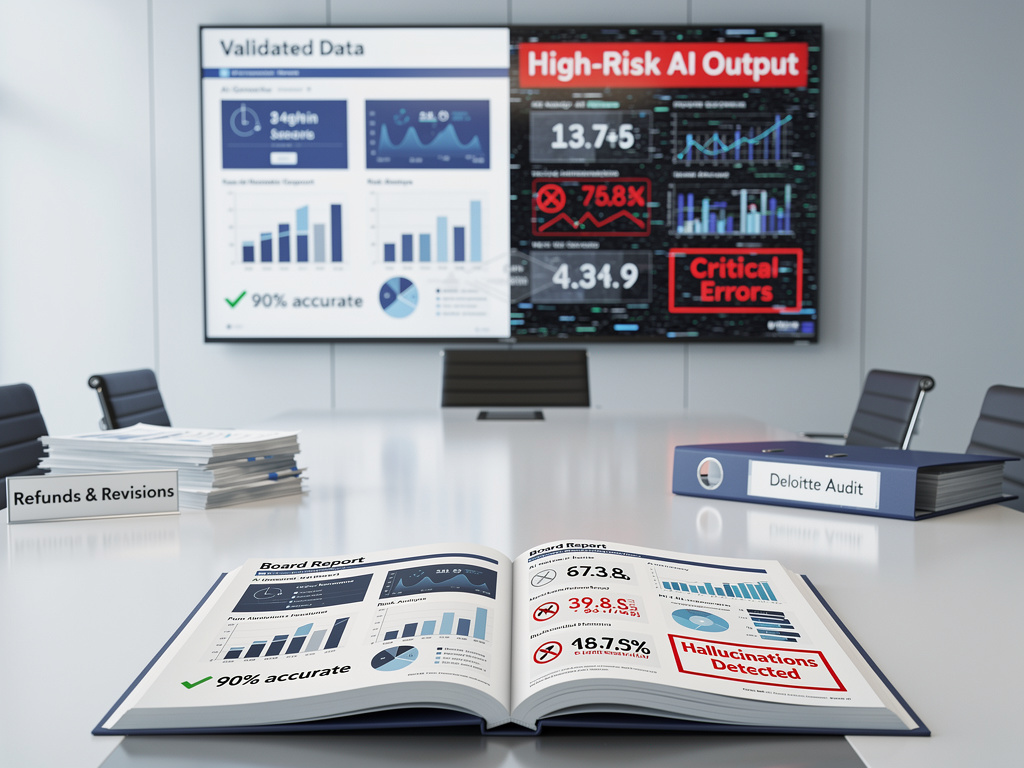
New reports confirm a troubling trend in corporate reliance on AI tools, revealing that while generative AI boasts a strong 90% accuracy rate, its frequent inaccuracies pose significant risks for businesses. A pointed analysis from AIJourn highlights how even minor errors can lead to catastrophic decision-making failures.
UPDATE: A CEO shared a shocking incident on X, where an AI-generated summary of investment documents contained a single fabricated term that could have derailed a multimillion-dollar deal, as noted by user @CynicalPublius. This alarming example underscores the growing concerns surrounding AI’s role in corporate decision-making.
According to the latest McKinsey State of AI 2024 survey, 44% of organizations have reported negative consequences due to generative AI, with inaccuracies leading the list of concerns, as detailed by Forbes. Even advanced models from OpenAI demonstrate troubling error rates, with recent data showing hallucination rates of 33% for public figure queries from model o3 and an alarming 48% for o4-mini.
The stakes are high, particularly for high-stakes business reports. In a notable case, Deloitte refunded $290,000 to the Australian government for a flawed 237-page welfare analysis riddled with inaccuracies, as reported by TechCrunch. Similarly, internal documents reveal that Amazon’s Q Business tool struggled with accuracy during its first year.
Workers are feeling the pressure, losing an average of 4.3 hours per week verifying AI-generated outputs, according to a 2025 study by Drainpipe.io. This inefficiency is compounded by the fact that even leading AI models are prone to hallucinations, with figures ranging from 10% for Claude to 57% for Inflection on news prompts, as highlighted in a Forbes report.
The implications extend beyond operational inefficiencies. Legal ramifications are emerging, with courts holding firms accountable for AI outputs, as seen in the case of Walters v. OpenAI. A staggering 89% of organizations are now monitoring AI agents, while 32% are implementing quality controls to mitigate risks, according to data from Maxim AI.
To address these challenges, 76% of firms are introducing human-in-the-loop checks, and 39% are reworking AI-generated content post-errors, as noted by Drainpipe.io. Microsoft is implementing a correction tool to revise AI outputs, but experts caution that this approach may mask underlying issues.
As businesses navigate this complex landscape, the demand for reliable verification layers becomes critical. Continuous monitoring, expert verification, and robust policy guardrails are essential to harness AI effectively. Analysts emphasize that while AI excels at generating fluent text, it often lacks the grounding necessary for accuracy.
Moving forward, leaders are urged to align AI strategies with business objectives, rigorously test AI outputs, and prioritize human oversight to maintain trust and accountability. The message is clear: the 90% accuracy touted by AI is not enough—corporate decisions depend on precision.
NEXT STEPS: As 2026 approaches, companies must recalibrate their evaluation processes, emphasizing accuracy over mere plausibility. The time saved in drafting reports can be quickly lost in corrections, making it imperative to prioritize flawless execution. The message from the boardroom is clear: when it comes to AI-generated content, perfection is non-negotiable.