







































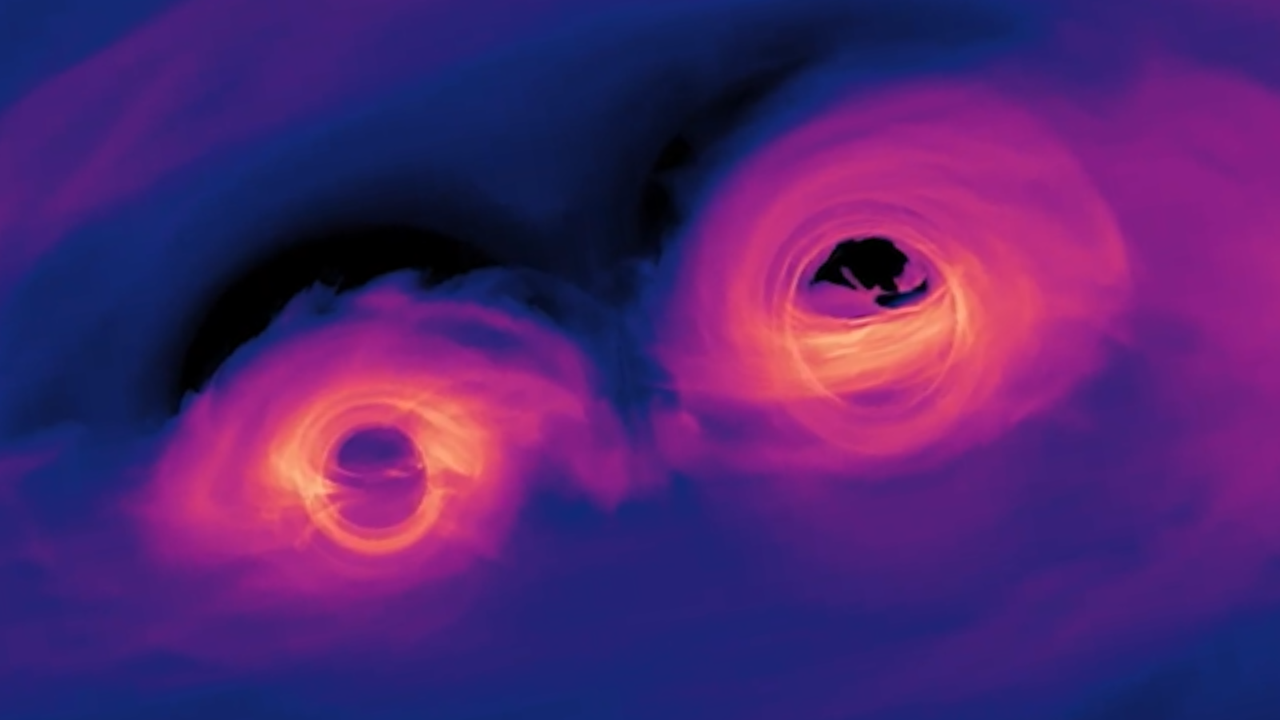
BREAKING NEWS: Scientists have just confirmed the discovery of two merging supermassive black holes named after iconic locations from J.R.R. Tolkien’s “Lord of the Rings.” The black hole binaries, designated as Gondor (SDSS J0729+4008) and Rohan (SDSS J1536+0411), were identified by the North American Nanohertz Observatory for Gravitational Waves (NANOGrav), utilizing a groundbreaking method that leverages gravitational waves.
This urgent update signals a major advancement in astrophysics. The detection of these black hole systems not only deepens our understanding of the cosmos but offers a new technique for mapping cosmic phenomena. The research was published on February 5, 2023, in The Astrophysical Journal Letters.
NANOGrav’s innovative approach capitalizes on the background hum of gravitational waves emitted by supermassive black hole binaries as they spiral closer together. This phenomenon allows scientists to identify the presence of these colossal entities through their interactions with quasars, which are bright regions powered by black holes consuming gas and dust.
Chiara Mingarelli, a key member of the NANOGrav team, stated,
“Our finding provides the scientific community with the first concrete benchmarks for developing and testing detection protocols for individual, continuous gravitational wave sources.”
The names Gondor and Rohan were inspired by both pop culture and individual contributions, with Rohan being named after Rohan Shivakumar, a Yale student who initially analyzed the black hole system. Mingarelli humorously noted, “Gondor was next, because, well — the beacons were lit!”
The study focused on 114 Active Galactic Nuclei (AGNs) and marks a significant step forward in the quest to understand how supermassive black holes merge and evolve over time. The team anticipates that even a modest catalog of black hole mergers could lead to the creation of a comprehensive gravitational wave background map.
NANOGrav, which first detected a gravitational wave background in 2023, is poised to continue its search for supermassive black hole binaries in the coming months. The implications of this research could revolutionize our comprehension of galaxy mergers, the intricacies of black hole physics, and the very nature of gravitational waves themselves.
As the scientific community eagerly processes these findings, NANOGrav’s efforts illustrate a roadmap for future supermassive black hole binary detection and exploration. This development isn’t just a win for astrophysics; it’s an invitation for humanity to reflect on our place in the universe, inspired by tales from fantasy that now resonate with real scientific achievements.
Stay tuned for more updates as NANOGrav continues its vital work in unraveling the mysteries of the cosmos.