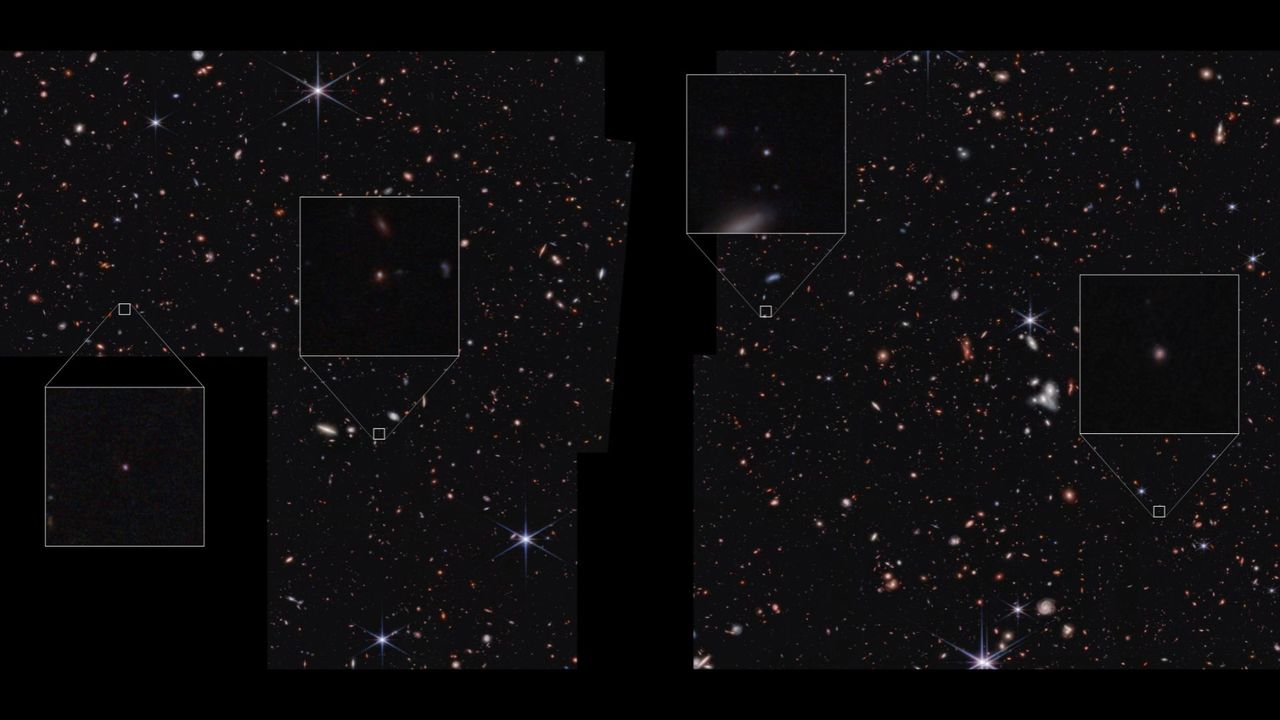
NASA’s James Webb Space Telescope (JWST) has identified a collection of peculiar cosmic objects that may redefine our understanding of galaxy formation. Dubbed “platypus” galaxies due to their hybrid characteristics resembling both stars and galaxies, these objects are captivating astronomers and prompting further investigation into the early universe.
At a news conference during the annual meeting of the American Astronomical Society in Phoenix on January 6, 2023, astronomer Haojing Yan from the University of Missouri shared insights on these discoveries. The JWST’s observations reveal features that suggest these objects could date back to the infancy of the universe, providing important clues about the formation of galaxies billions of years ago.
The JWST, which began operations in 2021, quickly began uncovering a range of unusual cosmic phenomena. Yan, along with two students, examined approximately 2,000 compact sources, ultimately identifying nine distinct objects that stood out. Initially appearing as small points of light, further analysis indicated that these objects were larger and more diffuse than typical stars.
Yan explained, “If you look at any of the features separately, just putting them together makes a platypus look so odd. Our objects are exactly like that.” While these objects closely resemble known classifications of quasars, they exhibit several key differences that suggest they may belong to an entirely new category.
Upon examining their spectral characteristics, researchers noted that the objects produced narrow emission lines, typically associated with active star formation in galaxies. This finding led them to consider the possibility that these objects might belong to a class of narrow-line AGN, although such entities usually present as point sources rather than point-like objects.
Yan stated, “Our objects are not quasars,” emphasizing the need for further classification. The researchers are also contemplating whether these unique objects could represent a new type of star-forming galaxy. Bangzheng Sun, another researcher from the University of Missouri, added that if these objects are indeed galaxies, they would be no older than 200 million years, indicating they are still in their early stages of development.
Sun described the potential implications of these findings, stating, “These galaxies must be sitting there, forming stars from the inside out. This is a process we have not seen before.” The researchers are particularly intrigued by the possibility that these cosmic bodies might be forming stars in a manner that is less chaotic than typically observed, which could help maintain their distinctive point-like appearance.
The discovery of these nine objects, which Yan refers to as “our platypuses,” is just the beginning. The team is excited about the prospect of identifying more examples in future JWST observations. As they continue to unravel the mysteries surrounding these cosmic anomalies, the implications for our understanding of galaxy formation in the early universe could be profound.
In summary, the peculiar characteristics of these newly discovered cosmic objects challenge existing classifications and may offer a glimpse into the processes that shaped the universe. Researchers are eager to explore the potential of these “platypus” galaxies and what they can teach us about the cosmos.