







































Researchers have uncovered a groundbreaking discovery regarding Earth’s inner core, revealing that it exists in a superionic state. Published on December 10, 2025, in the journal National Science Review, the study indicates that carbon atoms can move freely through a solid iron lattice, a phenomenon that could reshape our understanding of Earth’s internal structure and dynamics.
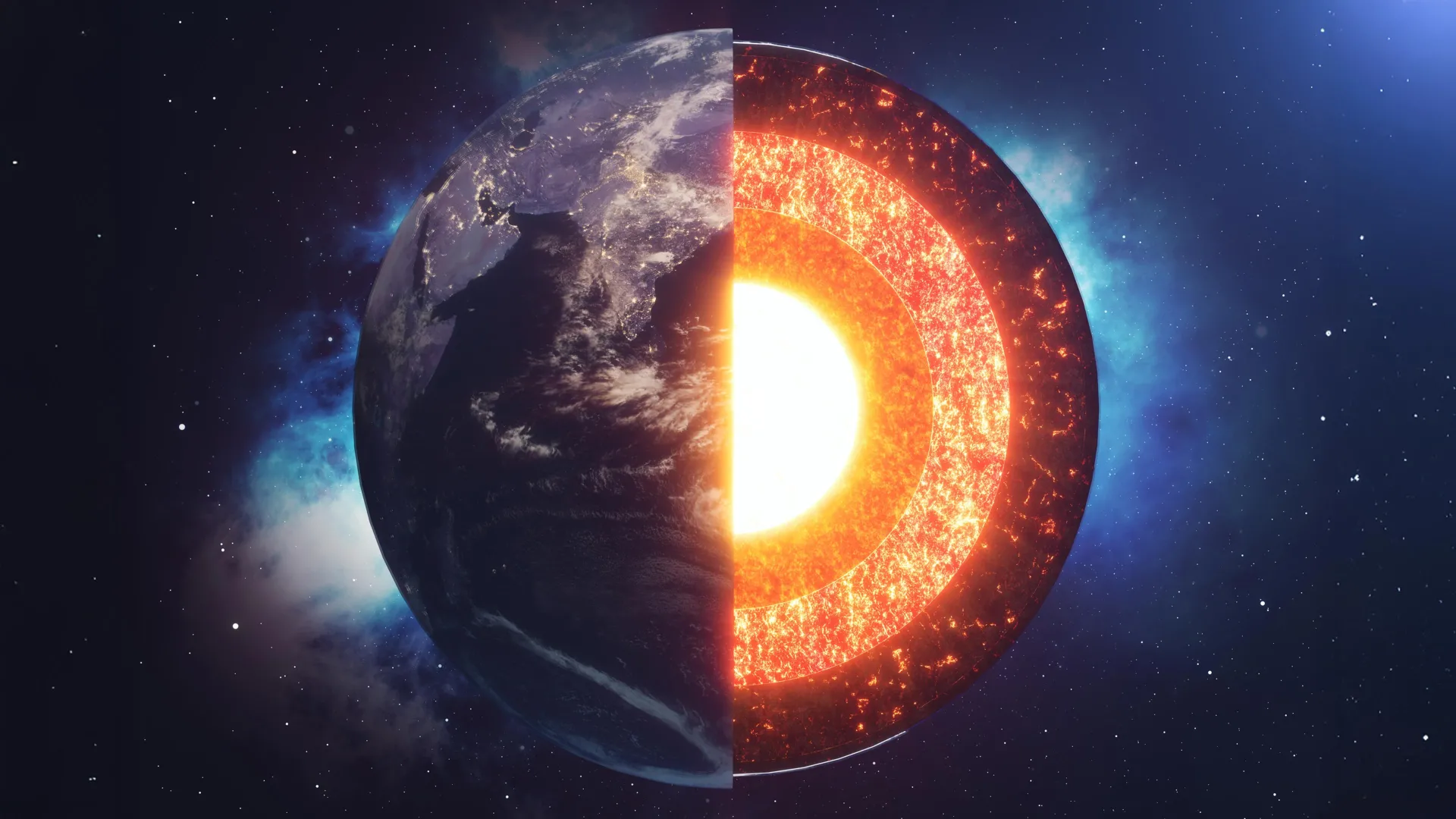
The inner core, a dense sphere composed of an iron and light-element alloy, is subjected to extreme conditions—pressures exceeding 3.3 million atmospheres and temperatures comparable to the Sun’s surface. For years, scientists have grappled with the peculiar behavior of this solid center, noting its surprising softness and its ability to slow down seismic shear waves, which has perplexed researchers.
Groundbreaking Findings on Inner Core Behavior
A research team led by Prof. Youjun Zhang and Dr. Yuqian Huang from Sichuan University, alongside Prof. Yu He from the Institute of Geochemistry at the Chinese Academy of Sciences, conducted experiments that provide a robust explanation for the inner core’s unusual characteristics. Their findings suggest that the iron-carbon alloy transitions into a superionic phase under the extreme pressures and temperatures found in the inner core.
In this state, carbon atoms move rapidly within the iron lattice, reducing the alloy’s rigidity significantly. Prof. Zhang noted, “For the first time, we’ve experimentally shown that iron-carbon alloy under inner core conditions exhibits a remarkably low shear velocity.” This indicates a crucial shift in how the inner core’s solid structure is perceived.
The team utilized a dynamic shock compression platform to simulate the extreme conditions of the inner core. By propelling iron-carbon samples at 7 kilometers per second, the researchers achieved pressures of up to 140 gigapascals and temperatures approaching 2,600 kelvin. These experiments confirmed earlier computer simulations that had suggested the existence of this exotic state.
Implications for Earth’s Magnetic Field and Beyond
The implications of this superionic model extend beyond resolving seismic anomalies. The motion of light elements such as carbon may provide an energy source for Earth’s magnetic field, contributing to the planet’s geodynamo. Dr. Huang remarked, “Atomic diffusion within the inner core represents a previously overlooked energy source for the geodynamo.” This finding could help explain seismic anisotropy, which refers to directional variations in seismic wave speeds.
This research also challenges previous assumptions regarding the behavior of light elements under intense pressure. Rather than focusing solely on compounds or substitutional alloys, the study emphasizes the significance of interstitial solid solutions, particularly those involving carbon, in determining the core’s physical properties.
According to Prof. Zhang, this discovery marks a significant transformation in how scientists view the inner core. “We’re moving away from a static, rigid model of the inner core toward a dynamic one,” he explained. The research not only enhances our understanding of Earth but also has potential applications for studying magnetic and thermal evolution in other rocky planets and exoplanets.
This work was supported by the National Natural Science Foundation of China, the Sichuan Science and Technology Program, and the CAS Youth Interdisciplinary Team. The findings bring scientists closer to unlocking the mysteries of planetary interiors, potentially reshaping our understanding of Earth and similar celestial bodies.