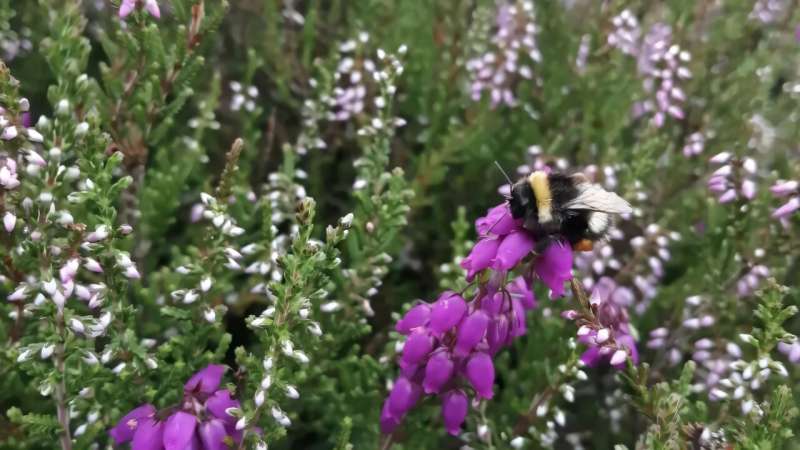
Research conducted by a team from Lund University reveals that honeybees are adversely impacting wild bumblebee populations in Ireland’s Wicklow Mountains. The study, published on December 10, 2025, in the journal Proceedings of the Royal Society B: Biological Sciences, indicates that the presence of honeybees alters the behavior and size of bumblebees in regions rich with flowering heather.
During the summer months, the slopes of the Wicklow Mountains bloom with vibrant heather, attracting beekeepers who relocate their honeybee colonies to harvest the prized heather honey. The study assessed areas with varying numbers of beehives, ranging from 0 to 35, and tracked the bumblebees’ movements over several weeks. The findings were striking: bumblebees exhibited shorter stays on heather flowers and increased movement speed, suggesting a scarcity of nectar and pollen.
Lina Herbertsson, a biology researcher at Lund University, noted, “We saw that the bumblebees adapted quite quickly once the honeybees were moved in.” The research shows that the bumblebee populations were not only behaving differently but were also smaller in size in areas with more honeybee hives. This size reduction may result from larger bumblebees fleeing to regions with fewer honeybees, while smaller bumblebees remained to forage when larger ones could not keep up.
The implications of this study extend beyond the Irish heathlands. Honeybees, bumblebees, and various wild bees play crucial roles in pollinating a wide array of plants, including fruits and crops. Wild pollinators are already under significant stress due to habitat loss, and the increasing numbers of honeybees further complicate their survival.
Herbertsson emphasized the need for balance, stating, “We hope our results can help beekeepers and conservation biologists plan beehive placement so that both honeybees and wild bumblebees can thrive.” Addressing the coexistence of these species is essential for maintaining biodiversity, food security, and the health of ecosystems.
The study’s findings highlight the delicate relationship between beekeeping practices and the survival of wild pollinators. As the demand for honey continues to rise, understanding how honeybee populations influence native wildlife will be vital for sustainable agricultural practices and environmental conservation.
For further details, the complete study can be accessed in the Proceedings of the Royal Society B, DOI: 10.1098/rspb.2025.1915.