























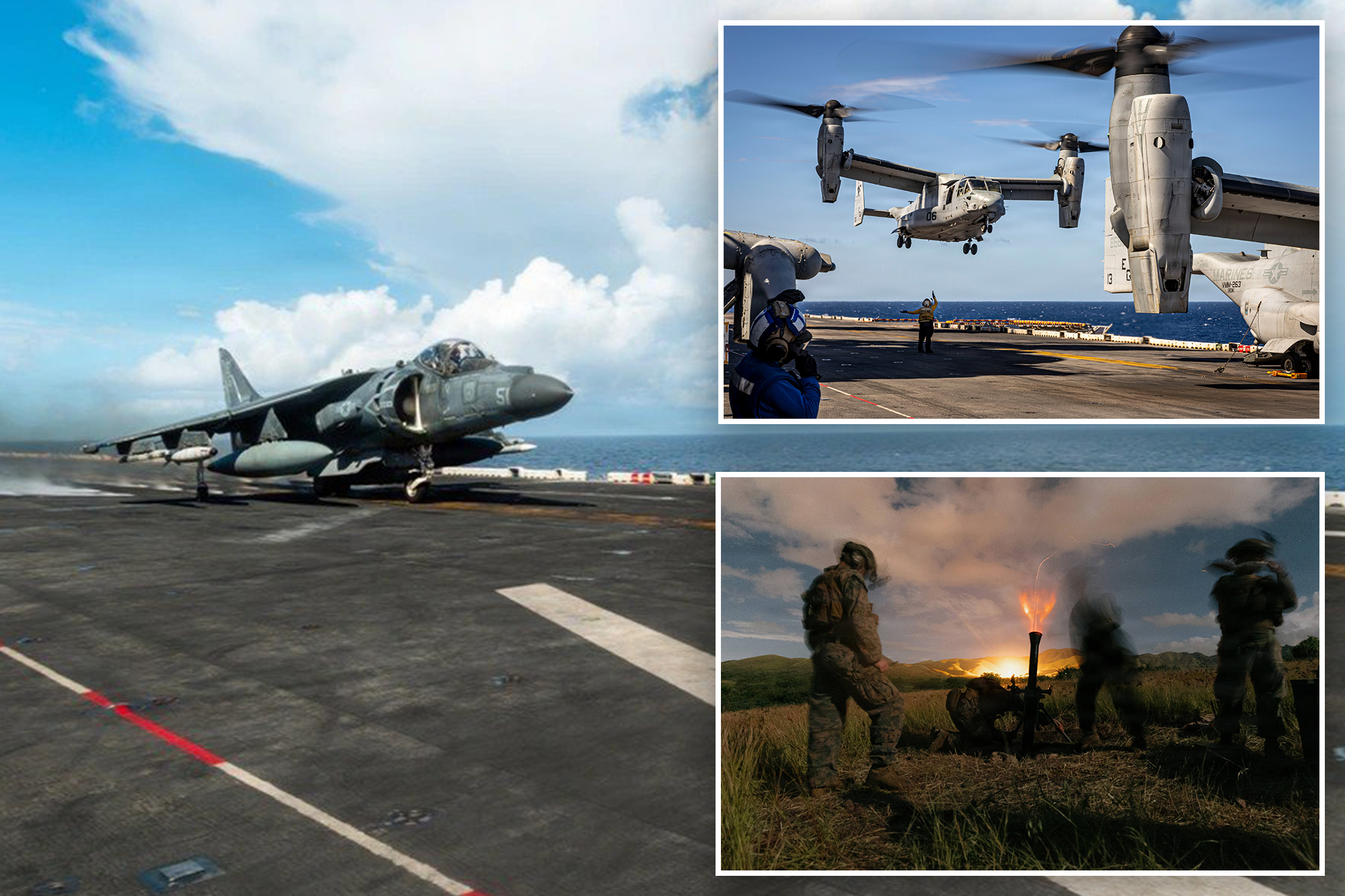
US Southern Command recently showcased the capabilities of approximately 2,200 Marines training in the Caribbean, coinciding with heightened tensions regarding the Venezuelan government led by Nicolas Maduro. This military display included live-fire exercises and drone operations, reflecting the Trump administration’s intensified pressure on Maduro’s regime.
Training Exercises Demonstrate Military Readiness
The 22nd Marine Expeditionary Force participated in various training sessions that highlighted their operational readiness. Photographic evidence released on December 16, 2023, captured Marines engaged in mortar system drills as part of “reconnaissance, selection and occupation of position” maneuvers. Additionally, they trained on first-person view attack drones in Puerto Rico and conducted flight operations aboard the amphibious assault ship USS Iwo Jima in the Caribbean Sea. These activities are part of a broader strategy to signal military capability to potential adversaries.
According to Alex Plitsas, a senior fellow at the Atlantic Council and former US intelligence officer, the military exercises are intended to demonstrate both capability and capacity. He noted, “It’s meant to demonstrate capability and capacity, and in some cases, it can also be signaling to adversaries.” Despite this show of force, Plitsas cautioned that the current troop level is insufficient for a ground invasion of Venezuela, estimating that around 100,000 troops would be necessary to effectively overthrow Maduro and stabilize the country.
US Policy on Venezuela and Regional Security
The military drills and the ongoing pressure on Maduro correspond with statements made by Marco Rubio, the US Secretary of State. Recently, Rubio emphasized that Maduro’s regime, which he described as the number one threat to American security in the Western hemisphere, must be addressed. He stated, “The status quo with the Venezuelan regime is intolerable for the United States,” underlining the administration’s commitment to seeking Maduro’s ouster.
Rubio raised concerns about Maduro’s ties to Hezbollah and other terrorist organizations, asserting that Venezuela allows these groups to operate freely within its borders. He pointed out that the regime not only facilitates drug trafficking but also permits Colombian terror groups such as the ELN and FARC to control parts of Venezuelan territory.
In a related development, the US Coast Guard is pursuing an oil tanker near Venezuela accused of engaging in illicit “black-market” oil shipments linked to the Maduro regime. The vessel, believed to be operating under a false flag, has been monitored by US military assets since at least the previous Sunday. If seized, it would mark the third tanker taken over by American forces in under two weeks.
The White House has defended its assertive posture as part of a larger strategy to cut off revenue sources for Maduro, who is thought to use oil sales to finance drug trafficking and criminal networks. Officials have described these tankers as part of a “shadow fleet” undermining international sanctions and energy regulations.
The unfolding situation underscores the United States’ ongoing efforts to counter the influence of the Venezuelan government in the region, highlighting the complex interplay between military readiness and diplomatic strategy.