






































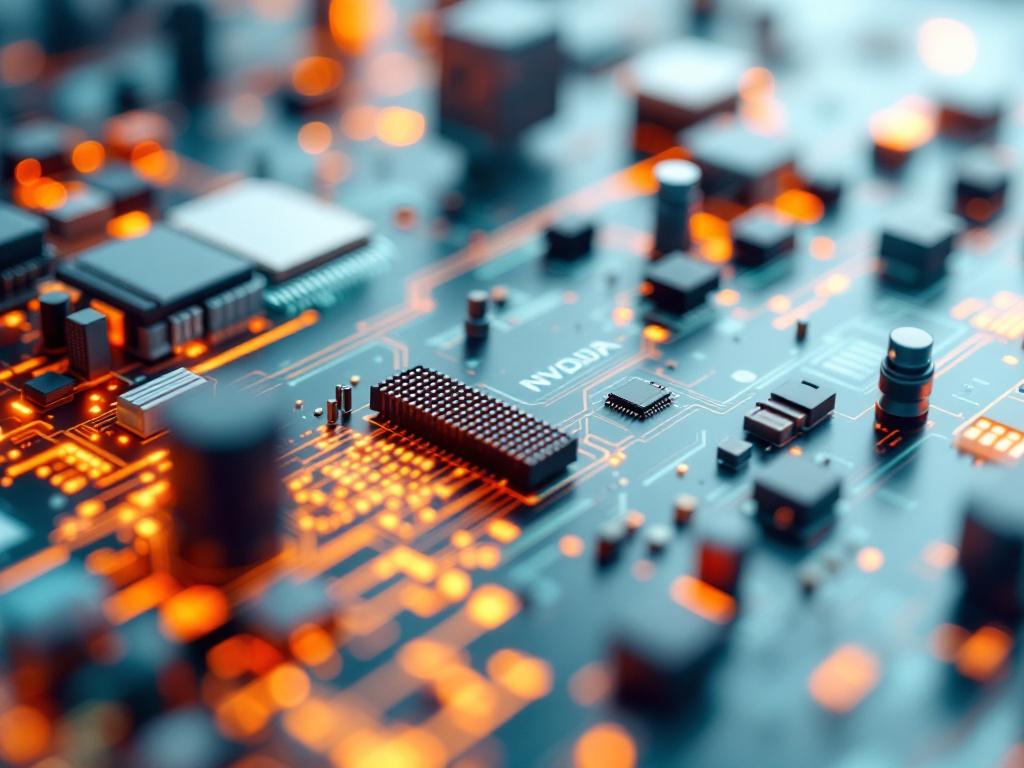
UPDATE: In a striking announcement, Nvidia Corp. claims it holds a full “generation lead” over Google’s custom AI chip efforts, marking a pivotal moment in the ongoing AI arms race. This announcement comes as tech giants invest heavily to reduce dependency on Nvidia’s cutting-edge H100 and Blackwell GPUs.
The revelation, reported by CNBC, highlights escalating tensions between chip suppliers and their major clients, including Google, Microsoft, and Amazon. These companies have historically relied on Nvidia while simultaneously developing their proprietary chips to cut costs. However, Nvidia’s latest statements signal a shift, as the company asserts that the performance gap between its solutions and Google’s Trillium chips is more pronounced than ever.
Nvidia’s confidence stems from its technological advantages in memory bandwidth and networking fabric, which Google’s Tensor Processing Unit (TPU) struggles to match at scale. According to industry experts, this performance edge is crucial for training next-generation AI models, where communication speed becomes as important as computation power.
“Google’s TPUs may excel in specific tasks, but they cannot replicate the cohesive power of Nvidia’s architecture,” stated an Nvidia executive, underlining the company’s position as the go-to provider for AI development. As AI models grow increasingly complex, the ability to efficiently transfer data between chips is vital.
The financial implications are significant. Google’s investment in TPUs is aimed at cutting down total cost of ownership, with reports indicating that for every dollar spent on internal silicon, the company saves substantially compared to purchasing from Nvidia. Yet Nvidia argues that the time-to-intelligence advantage it offers outweighs these savings. If Nvidia’s clusters can train a model three months faster than Google’s equivalent, the urgency becomes clear: speed is paramount in the rapidly evolving AI landscape.
Additionally, supply chain dynamics play a critical role. Both companies rely on TSMC for manufacturing, which means any delays or bottlenecks affect them equally. Nvidia’s assertions suggest that even if Google designs competitive chips, it cannot innovate faster than Nvidia, which dedicates its resources solely to improving chip performance.
The software ecosystem further complicates the landscape. Nvidia’s CUDA platform remains the industry standard, making it challenging for Google’s JAX and XLA alternatives to gain traction. The majority of AI development occurs on Nvidia hardware, and porting code to run efficiently on TPUs can incur significant engineering costs that many companies are reluctant to absorb.
Nvidia’s declaration of being “a generation ahead” serves as a stark reminder of the fragmented nature of the AI tech landscape. If tech giants continue to build isolated silicon solutions, the interoperability of AI models could suffer, hindering innovation across the sector.
Wall Street analysts are closely monitoring this escalating rivalry. According to Barron’s, Nvidia’s bold claims might protect its gross margins, which are at historic highs. Should the market view Google’s TPUs as adequate substitutes, Nvidia risks losing pricing power. However, if Nvidia’s lead is validated, it could continue commanding premium prices even as production scales up.
The cloud computing market is also feeling the effects of this conflict. With third-party providers struggling to secure enough Nvidia compute power, Google’s TPU-equipped cloud options become increasingly appealing, albeit with the risk of compromising quality. Nvidia’s disparaging remarks about rival chips subtly pressure enterprise CIOs to favor its offerings, compelling Google to continue purchasing Nvidia GPUs to meet customer needs.
As the AI sector matures, experts predict a future of heterogeneous computing. Nvidia’s high-performance GPUs may excel in demanding training scenarios, while Google’s TPUs efficiently manage routine inference tasks. While Nvidia may currently claim superiority in peak performance, Google’s efficiency gains in everyday operations remain substantial.
The rivalry between Nvidia and Google reflects the high stakes of the evolving AI industry. Nvidia’s assertion serves as a wake-up call that maintaining industry dominance requires constant innovation and adaptation. As the battle for AI supremacy unfolds, tech giants will continue to invest heavily in their silicon futures, ensuring that the competition remains fierce and dynamic.
Stay tuned for further updates on this developing story.