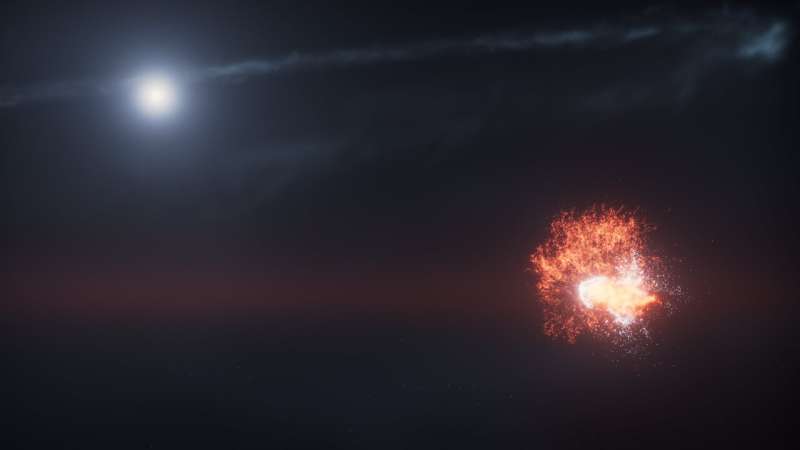
NASA’s Hubble Space Telescope (HST) has captured a remarkable astronomical event: the aftermath of two colliding space rocks in the nearby Fomalhaut planetary system. This discovery marks the first time such collisions have been observed outside our solar system, providing valuable insights into the processes involved in planet formation.
Initially, astronomers identified a bright object in the Fomalhaut system, leading them to believe it was a dust-covered exoplanet reflecting starlight. However, when the supposed exoplanet vanished and a new luminous object appeared, a team of international astrophysicists, including Jason Wang from Northwestern University, realized they were witnessing not planets, but the brilliant remnants of a cosmic collision.
Unveiling the Collision
The research, published in the journal Science, reveals that two violent collisions occurred, generating luminous clouds of debris. “Spotting a new light source in the dust belt around a star was surprising,” Wang stated. “Our primary hypothesis is that we saw two collisions of planetesimals—small rocky objects, similar to asteroids—over the last two decades.” These events are rare, with theoretical models suggesting one collision every 100,000 years or more.
Lead author Paul Kalas, an astronomer at the University of California, Berkeley, expressed his astonishment: “This is certainly the first time I’ve ever seen a point of light appear out of nowhere in an exoplanetary system.” The team has been monitoring the Fomalhaut system for two decades, making it an ideal target for such observations.
Located just 25 light-years from Earth in the Piscis Austrinus constellation, Fomalhaut is surrounded by an extensive system of dusty debris belts. Since its initial identification in 2008, astronomers have debated whether Fomalhaut b was a legitimate planet or merely a large cloud of dust. In 2023, HST observations revealed that Fomalhaut b had disappeared, replaced by another bright point of light, now designated Fomalhaut cs2.
Implications for Planetary Science
The disappearance of Fomalhaut b supports the theory that it was a dispersing dust cloud created by a collision. The emergence of Fomalhaut cs2 reinforces the idea that both are remnants of dramatic impacts between planetesimals, rather than actual planets. The brightness and location of Fomalhaut cs2 closely resemble initial observations of Fomalhaut cs1 from two decades ago.
Kalas highlighted the significance of these findings, stating, “If you had a movie of the last 3,000 years, sped up so that each year was a fraction of a second, imagine how many flashes you’d see over that time. Fomalhaut’s planetary system would be sparkling with these collisions.”
Wang contributed to confirming the detection of these transient events through his independent analyses. “We had to make sure we could trust our images and measure the properties of the collision accurately,” he said.
While this discovery presents a rare opportunity to observe cosmic collisions, it also serves as a reminder of the challenges in distinguishing between genuine exoplanets and the transient clouds created by such events. Kalas cautioned, “Fomalhaut cs2 looks exactly like an extrasolar planet reflecting starlight. What we learned from studying cs1 is that a large dust cloud can masquerade as a planet for many years.”
Although Fomalhaut cs1 has faded from view, the research team plans to continue monitoring the Fomalhaut system. They will utilize the Near-Infrared Camera (NIRCam) on NASA’s James Webb Space Telescope (JWST) to gather more data. This advanced instrument can provide color information that HST was unable to capture, revealing the size and composition of the dust grains, including potential water and ice content.
Wang expressed optimism about future observations, stating, “We have an approved JWST program to follow up this planetesimal collision to understand the new circumstellar source and the nature of its two parent planetesimals that collided.”
This groundbreaking research not only enhances our understanding of planetary formation but also underscores the importance of continued observation in the Fomalhaut system, as astronomers strive to uncover the mysteries of our universe.