








































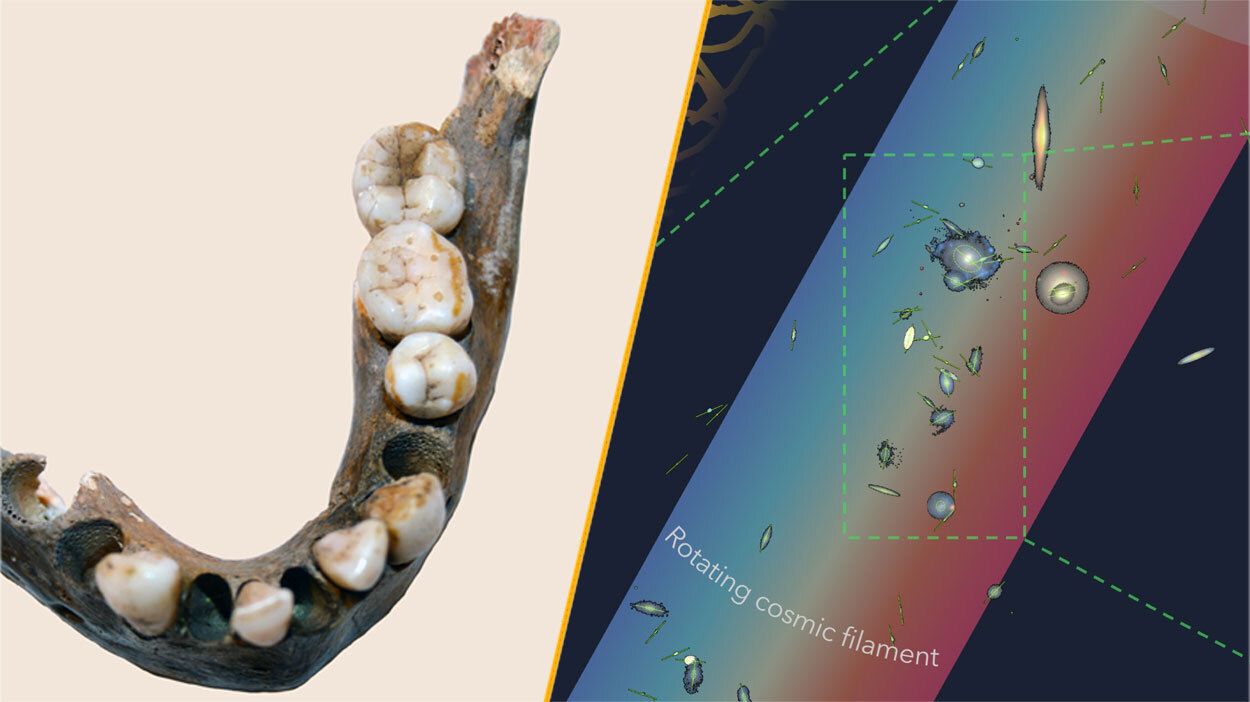
BREAKING NEWS: Scientists have just unveiled three monumental discoveries that are reshaping our understanding of history and the universe. This week, a colossal spinning structure, the largest ever observed, was identified **140 million light-years** away, while researchers in southern Africa reported on a human population that remained genetically isolated for **100,000 years**. Additionally, archaeologists in China uncovered a disturbing pit of skulls linked to ancient rituals.
In a groundbreaking revelation, astronomers have identified the **largest spinning filament** in the universe, surpassing the size of the **Milky Way**. This extraordinary filament, part of a network of **14 galaxies**, is rotating at an astonishing **68 miles per second** (110 kilometers per second). The discovery provides crucial insights into the formation and evolution of cosmic structures.
Closer to home, a study of human skeletons found near the **Limpopo River** in southern Africa has revealed that a distinct human population existed for **100,000 years** in isolation. The remains, dating back up to **10,000 years**, exhibited a genetic makeup vastly different from modern humans. Researchers noted that these individuals represent an “extreme end of human genetic variation,” highlighting the diverse tapestry of human evolution.
Meanwhile, a shocking discovery outside a **4,000-year-old city in China** has archaeologists puzzled. A massive pit filled with skulls predominantly from males deviates from traditional sacrificial patterns seen in nearby settlements. This find raises questions about ancient societal practices and the lives of these individuals.
On a related note, researchers reported alarming findings regarding a tree-planting project in China aimed at combating desertification. While the **Great Green Wall** has effectively halted the spread of deserts, it has inadvertently altered rainfall and evaporation patterns, leading to significant drops in water levels across densely populated regions.
In a separate but equally captivating story, the world’s hottest temperature record, set in **Death Valley** in **1913**, may have been influenced by human error, according to recent research. This revelation could have implications for how we understand historical climate data.
Turning our gaze to the cosmos, comet **3I/ATLAS** is currently erupting with what appears to be “ice volcanoes,” as observed by researchers at the **Montsec Observatory** in northeastern Spain. This interstellar visitor is exhibiting spiral jets, suggesting that as it approaches the sun, ice is sublimating from its surface, similar to other bodies in our solar system.
In technological innovation, engineers at **MIT** have developed a groundbreaking technique to extract drinking water from the air using sound waves. This method, which is **45 times more efficient** than traditional evaporation techniques, could revolutionize water access in arid regions.
Lastly, in a remarkable find, scientists in Bolivia have discovered **18,000 dinosaur tracks**, setting a new record for the area known as **Carreras Pampa**. This extensive trail of fossilized footprints spans **80,570 square feet** (7,485 square meters), providing valuable insights into the behaviors and movements of ancient dinosaurs.
These discoveries highlight the relentless pursuit of knowledge in science, revealing both the mysteries of our past and the potential for future advancements. As these stories develop, they remind us of the interconnectedness of humanity and the universe. Stay tuned for more updates as researchers continue to unravel the secrets of our world and beyond.