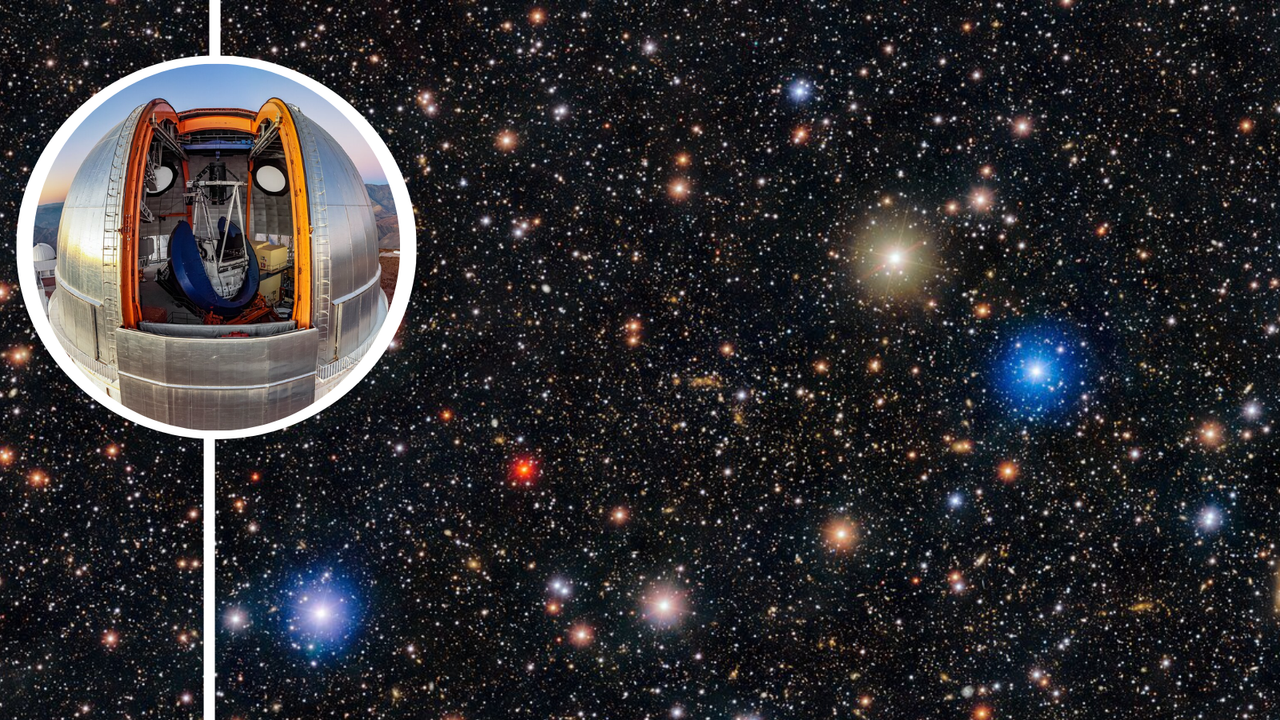
Scientists have achieved a significant breakthrough in understanding the universe’s expansion and the enigmatic force known as dark energy. This development follows an extensive analysis of six years’ worth of data collected by the Dark Energy Camera (DECam), which is mounted on the National Science Foundation‘s Víctor M. Blanco 4-meter telescope. The analysis comprises observations from 758 nights covering one-eighth of the sky, conducted by the Dark Energy Survey (DES) Collaboration between 2013 and 2019.
The study, which utilized a 570-megapixel DECam, gathered information from approximately 669 million galaxies located billions of light-years from Earth. This research marks the first time that four distinct methods of studying dark energy have been combined, significantly enhancing the understanding of this elusive force that constitutes around 68% of the universe’s total energy and matter budget.
Unifying Observations for Greater Insight
The findings from this analysis have effectively doubled the constraints on the effects of dark energy, a critical advancement in uncovering its true nature. “These results from DES shine new light on our understanding of the universe and its expansion,” stated Regina Rameika, Associate Director for the Office of High Energy Physics in the Department of Energy’s Office of Science. She emphasized the importance of long-term investment in research and the integration of multiple analytical approaches.
The initial evidence for dark energy emerged in 1998 when astronomers observed that distant supernovas were receding faster as they were further away. This discovery not only affirmed the expansion of the universe—first suggested by Edwin Hubble—but also revealed that this expansion is accelerating. Dark energy acts as a placeholder for the unknown force driving this acceleration.
Since the groundbreaking discovery, researchers have established that dark energy’s influence began to dominate the cosmos approximately 3 to 7 billion years ago, overcoming the gravitational pull of matter at large scales. This ongoing exploration underscores the need for a deeper understanding of dark energy.
Innovative Techniques and Future Directions
The recent analysis included observations of Type-Ia supernovas, the same type that led to the initial discovery of dark energy, along with three additional probes: weak gravitational lensing, galaxy clustering, and baryon acoustic oscillations. These diverse phenomena provide a comprehensive view of cosmic structure and expansion.
“It is an incredible feeling to see these results based on all the data, and with all four probes that DES had planned,” expressed Yuanyuan Zhang, a member of the DES Collaboration. “This was something I would have only dared to dream about when DES started collecting data, and now the dream has come true.”
Utilizing the data from DECam, the DES team reconstructed the distribution of matter over the past 6 billion years. They compared their findings against two prevailing cosmological models: the Lambda Cold Dark Matter (LCDM) model, which posits a stable dark energy, and the evolving model (w CDM). Their results aligned well with both models; however, discrepancies emerged regarding how matter clusters in the modern universe, indicating a significant deviation from predictions based on early universe measurements.
Looking ahead, the DES team plans to integrate DECam data with observations from approximately 20 billion galaxies using the Vera C. Rubin Observatory, set to commence its decade-long Legacy Survey of Space and Time (LSST). This collaboration aims to further illuminate the history of the universe and the complex nature of dark energy.
“DES has been transformative, and the Vera C. Rubin Observatory will take us even further,” noted Chris Davis, Program Director at the National Science Foundation. “Rubin’s unprecedented survey of the southern sky will enable new tests of gravity and shed light on dark energy.”
The research conducted by the DES team has been submitted to the journal Physical Review D and is available on the paper repository site arXiv. This advancement marks a promising step toward unlocking the mysteries surrounding dark energy and the universe’s expansion.