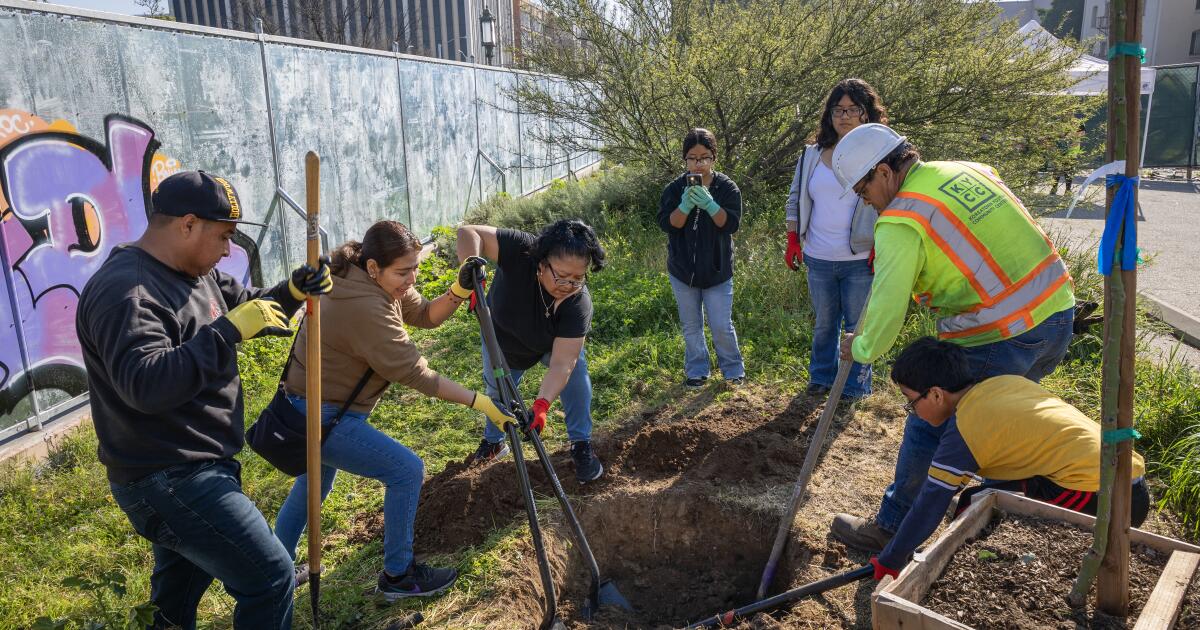
A groundbreaking analysis has uncovered that approximately 44% of the 312,000 acres of pavement in Los Angeles County may be unnecessary. This finding comes from a new report titled DepaveLA, which provides a detailed mapping of the county’s paved surfaces. Researchers assert that much of this pavement does not serve essential functions such as roads, sidewalks, or parking lots, suggesting that many areas could benefit from reconsideration.
The report marks the first parcel-level analysis of all paved surfaces in the region, distinguishing between streets, sidewalks, private properties, and other paved areas. Researchers categorized the pavement into “core” and “non-core” uses, identifying streets as core. They combined this mapping with data on heat, flooding, and tree canopy, aiming to create a framework to evaluate where removing asphalt could improve community health and address climate challenges.
Paved areas tend to absorb heat more than green spaces, contributing to higher temperatures and increased ozone levels in urban environments. Brent Bucknum, founder of Hyphae Design Laboratory, noted that greener areas offer psychological benefits as well, providing relief from the stress of urban life.
Reimagining Urban Spaces
The analysis revealed a surprising concentration of non-core pavement, with nearly 70% located on private property. Rather than advocating for extensive removal of pavement, the report highlights smaller, impactful changes. One significant opportunity lies in redesigning parking lots. Converting traditional 90-degree parking spaces to angled configurations could potentially eliminate up to 1,600 acres of pavement while maintaining parking capacity.
Bucknum emphasized the need for thoughtful design in these spaces, stating, “I’m often amazed — I’ll drive into a parking lot and there’s beeping, bumper-to-bumper traffic, you’re under this sweltering heat trying to get out of the grocery store. The reality is, we can make it a lot nicer with more thoughtful design.”
Ben Stapleton, CEO of the U.S. Green Building Council California, pointed out that outdated parking requirements often link the number of spaces to a building’s size. This has led developers to opt for pavement, which is cheaper and requires less maintenance.
Residential properties also present opportunities for reducing pavement. Bucknum suggested that if each residential parcel created a 6-by-6-foot tree well, it could collectively remove 1,530 acres of pavement while only slightly reducing patio space.
Emily Tyrer, director of green infrastructure at TreePeople, noted a concerning trend of increasing pavement in residential yards. “What we’re seeing is that a lot of residential yards are moving toward more paving and less lawn,” she said, attributing it to drought messaging and rising water costs. While paving may lower water usage and bills, it has significant trade-offs, including reduced green space.
Improving Community Health and Environment
Schools are another focal point for potential improvements. On average, school campuses in Los Angeles County are around 40% paved, exposing students to extreme heat. At Esperanza Elementary School, located near downtown Los Angeles, the campus was described as “just a sea of asphalt.” Tori Kjer, executive director of the Los Angeles Neighborhood Land Trust, is overseeing a transformation that will introduce California native plants, shade trees, and areas for outdoor activities.
Kjer highlighted the lack of open spaces for families living in small apartments, stating, “People don’t have any open space. They leave their home, and they’re basically just on concrete streets and sidewalks.” The planned changes aim to provide a more inviting environment for children to engage in imaginative and active play.
The idea behind the Depave report emerged from years of experience in tree planting and green infrastructure projects, often hindered by the overwhelming presence of pavement. “We were trying to plant trees, but so much of the city is paved that there was nowhere to put them,” Bucknum explained. The team recognized the need for better data to understand the pavement issue at a localized level.
Devon Provo, senior manager at Accelerate Resilience L.A., described the report as an opportunity assessment rather than a prescriptive plan. “It’s a starting point for conversation about how to make Los Angeles cooler, healthier, and more vibrant,” he said.
While the report presents valuable insights, there are challenges to consider. Olivier Sommerhalder, a principal at Gensler, noted that businesses that have invested in paving need incentives to reduce hardscaping. “The municipality does not incentivize the removal of parking to mitigate urban heat hot spots,” he said.
Bucknum suggested that a lawn replacement program could serve as a model for incentivizing pavement reduction. Such programs have successfully encouraged the community to adopt more sustainable landscaping practices.
Moreover, Carlos Moran, executive director of North East Trees, emphasized the need to consider what lies beneath the pavement, especially in areas with industrial histories. “We can’t just rip it out,” he cautioned, acknowledging the potential contamination risks.
Ultimately, the goal of the report is to influence how Angelenos and decision-makers perceive pavement. “This data is relevant to anyone who wants to have a say in reimagining the future of Los Angeles,” Provo stated. With this new perspective, stakeholders may rethink how much concrete their projects require and what benefits could arise from replacing it with greener alternatives.