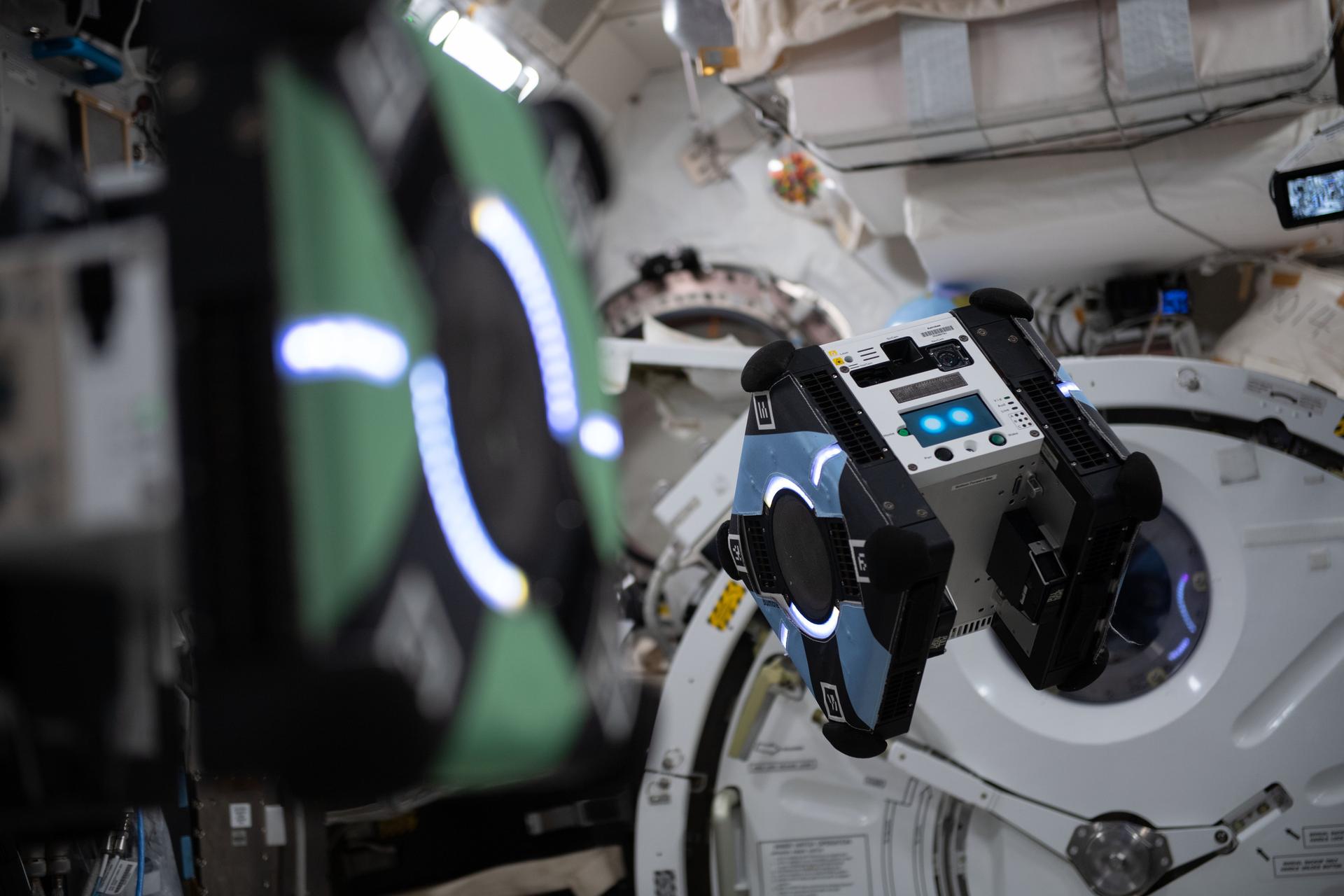
The National Aeronautics and Space Administration (NASA) has significantly improved the navigation of its autonomous robots aboard the International Space Station (ISS) by developing a new algorithm in collaboration with Professor Pyojin Kim from the Gwangju Institute of Science and Technology (GIST). This advancement addresses persistent issues caused by the lack of gravity, allowing robots like Astrobee to perform complex tasks without requiring human intervention.
Overcoming Navigation Challenges in Microgravity
In space, traditional tools often fail to function as intended. For example, a standard ballpoint pen cannot write in a microgravity environment due to ink flow issues. Similarly, autonomous robots aboard the ISS face challenges in maintaining their orientation and position. Without the gravitational pull that guides terrestrial robots, these machines frequently lose their bearings, leading to errors that can disrupt critical research performed by astronauts.
Previously, astronauts had to manually recalibrate these robots, which interrupted their tightly scheduled tasks. Recognizing this inefficiency, NASA sought a more reliable solution, leading to its partnership with Professor Kim. By developing a new algorithm, the team has managed to reduce the absolute rotation error of the robots to approximately 1–2 degrees, enabling them to operate autonomously over extended periods.
Innovative Digital Twin Technology
Astrobee, one of NASA’s free-flying robots, is designed to take over routine chores aboard the ISS, allowing astronauts to focus on more complex scientific research. However, the robot often struggled to maintain its orientation, prompting the need for a robust navigation solution.
The difficulty arises from the absence of a gravitational reference point, which terrestrial robots rely on through Inertial Measurement Units (IMUs). As Professor Kim notes, “Terrestrial navigation algorithms are designed based on gravity, making them difficult to apply directly in space where reference points are missing.” As a result, minor errors accumulate, leading to significant disorientation.
The breakthrough came when the team integrated Visual-Based Navigation (VBN) into the robot’s systems. Initial efforts to adapt existing Earth-based technologies proved ineffective due to the ISS’s chaotic interior environment, filled with cables and floating objects that obstruct the robot’s view. “We thought we could apply Earth-based technology,” recalls Professor Kim. “It did not perform reliably in the ISS environments.”
To tackle this, the researchers created digital twins—precise 3D replicas of the ISS, free from visual distractions. By using NASA’s blueprints, the team developed a virtual model that the robot could reference to filter out the clutter in real-time footage. This allowed Astrobee to interpret its environment as a series of geometric shapes, serving as a “visual compass” that provided accurate directional references.
By applying this innovative approach, the average rotational error was reduced to 1.43 degrees, establishing what the team calls “drift-free” navigation. This advancement not only enhances the functionality of NASA’s robots but also opens up potential applications on Earth, particularly for drones and indoor navigation systems.
Future Applications and the Importance of Space Exploration
Professor Kim believes that the insights gained from this research will have far-reaching implications beyond space. The principles of using visual data to navigate complex environments can be utilized in urban settings, where GPS signals are often unreliable. “Orientation techniques based on these structural features are applicable not only to space stations but also to typical urban settings,” he states.
Reflecting on the significance of space exploration, Professor Kim emphasizes the economic potential of ventures beyond Earth. “Because space now holds real economic and industrial value, showing commercial potential,” he asserts. With companies like SpaceX paving the way for commercial space activities, the collaboration between NASA and startups is becoming increasingly vital. NASA’s extensive technological foundation and expertise are essential for these new enterprises to thrive.
Professor Kim’s journey into this research area began with an internship during his doctoral studies at the NASA Ames Research Center, where he was involved in the development of Astrobee. His familiarity with both terrestrial drones and space robots has allowed him to bridge the gap between the two fields, leading to fruitful collaborations.
He expresses gratitude for the mentorship he received at NASA, particularly from Dr. Brian Coltin and other colleagues. “This research would have been impossible without the help of my mentor at the time, Dr. Brian Coltin, my NASA colleagues, and my current co-researcher, Dr. Ryan Soussan,” he says.
Professor Kim’s experience also highlights NASA’s unique approach to innovation. He notes that the agency’s willingness to embrace failure in pursuit of breakthroughs sets it apart from many other organizations. “Only successful projects are publicized, but behind every public triumph lie dozens of quiet failures,” he explains. This attitude fosters an environment where meaningful research can flourish.
As both NASA and the private sector continue to evolve, the integration of advanced navigation technologies like those developed by Professor Kim’s team will play a crucial role in future space missions and beyond. For those aspiring to contribute to this field, he advises, “You must excel at mathematics and your studies in general. While it is good to dream big, making that dream a reality requires overwhelming competence.”