






































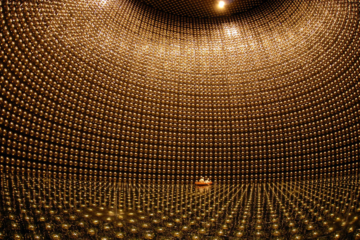
Recent research from two major experiments has shed light on the fundamental question of why matter exists in the universe. The studies, conducted by the NOvA collaboration at Fermilab in Illinois and the T2K experiment in Japan, have combined their findings for the first time. Published in October 2023 in the journal Nature, these results address the long-standing mystery surrounding neutrinos—particles that play a critical role in the formation of matter.
Understanding Neutrinos and Their Role
The prevailing theory suggests that at the moment of the Big Bang, equal amounts of matter and antimatter were created. If this were entirely accurate, both would have annihilated each other, leaving only energy. Instead, a slight surplus of matter has survived, leading to the universe as we know it today. According to Tricia Vahle, a professor of physics at William & Mary, neutrinos may hold the key to understanding this imbalance.
Vahle explains that neutrinos were once viewed as anomalies. They are produced through fusion reactions in the sun, and scientists have long struggled to account for the number of neutrinos reaching Earth. “They found far too few of them to explain how bright the sun was,” Vahle noted. The search for these elusive particles has been a central focus for particle physicists for decades.
Collaborative Efforts Yield Insights
The NOvA and T2K experiments aim to explore the behavior of neutrinos by sending beams of these particles to detectors located hundreds of kilometers away. The NOvA collaboration consists of over 250 scientists and engineers from 49 institutions across eight countries. Their experimental setup involves firing an intense beam of neutrinos from Fermilab through the Earth’s crust to a detector in Ash River, Minnesota, located 810 kilometers away. The particles complete this journey in less than three milliseconds.
Simultaneously, the T2K collaboration includes more than 560 members from 75 institutions across 15 countries, directing a neutrino beam over 295 kilometers from Tokai to the Super-Kamiokande detector in Kamioka, Japan. “With enough neutrinos and a large enough detector, sometimes we get lucky,” Vahle remarked. By comparing results, researchers can achieve a more comprehensive understanding of neutrino oscillation, a phenomenon where neutrinos change their identity as they travel.
This joint analysis marks a significant step forward, yielding the most precise measurements to date regarding the mass differences between neutrinos. The findings reveal two potential scenarios: if neutrinos follow an inverted mass ordering, they may violate charge-parity symmetry, providing insight into why matter prevails over antimatter. Conversely, if they follow a normal mass ordering, the role of neutrinos in explaining this asymmetry remains uncertain.
The analysis incorporates six years of data from NOvA and eight years from T2K, with Vahle expressing optimism for future collaboration between the two experiments. “Nature is revealing that our current models of nature are lacking,” she stated. As both teams continue to collect new data, they will integrate findings from upcoming neutrino experiments, fostering a deeper understanding of the universe.