








































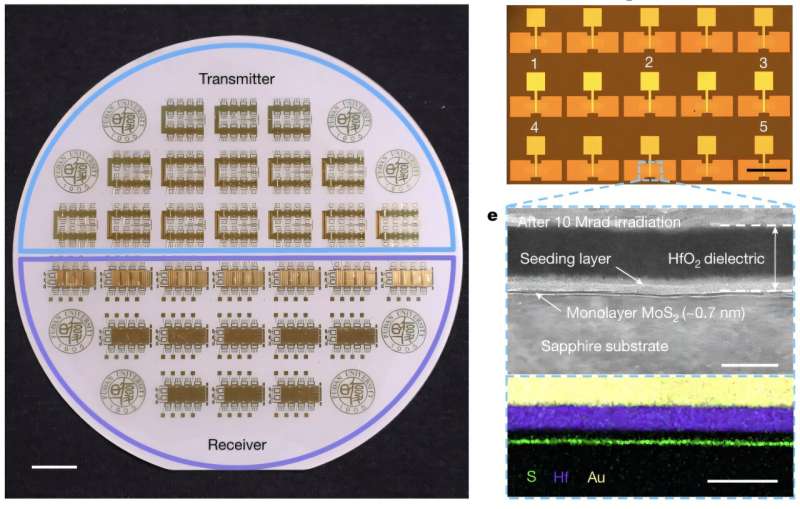
Researchers at Fudan University in China have made significant strides in developing atom-thin electronics made from molybdenum disulfide (MoS2), demonstrating their potential to withstand the harsh conditions of space. A study published in the journal Nature details how these materials could ensure the longevity of spacecraft electronics, possibly surviving for up to 271 years in geosynchronous orbit.
The electronic components of spacecraft face relentless exposure to cosmic rays and heavy ions beyond Earth’s protective magnetic field. Traditional solutions often involve adding heavy, radiation-protective materials, which can increase the launch costs and limit the payload capacity. Instead, the Fudan University team focused on creating electronics that are inherently resistant to radiation damage.
In their research, led by Peng Zhou, the team fabricated a radio-frequency communications system using a monolayer of MoS2, just 0.7 nanometers thick. Previous studies had shown that this material was robust against radiation-induced defects, but this latest investigation subjected it to rigorous testing.
The researchers exposed the MoS2 circuits to powerful gamma rays, simulating the radiation environment encountered in space. They employed advanced imaging techniques, including transmission electron microscopy and energy-dispersive spectroscopy, to examine the material’s condition before and after exposure. The results were promising—no significant structural or chemical damage was detected.
Following laboratory tests, the team advanced to practical applications by launching their MoS2-based circuit into low-Earth orbit, approximately 500 kilometers above the Earth. During the nine-month experiment, the device performed remarkably well, maintaining data transmission with an extremely low error rate. By the end of the test, it successfully received and transmitted the complete Anthem of Fudan University with perfect clarity.
The implications of these findings could be profound for the future of space exploration. If the durability of MoS2 electronics is validated in future missions, they could offer a lighter and more efficient alternative to conventional silicon-based technologies. This advancement could lead to enhanced spacecraft capabilities for deep-space exploration and improved communications in high-orbit environments.
The study, titled “Radiation-tolerant atomic-layer-scale RF system for spaceborne communication,” highlights the potential of using atomically thin materials in aerospace applications. As the field of space technology evolves, innovations like these may play a crucial role in enabling more sustainable and long-lasting missions beyond Earth.
As the research continues, the scientific community will be watching closely to see how these atom-thin electronics perform in various space missions, paving the way for a new era of resilient spacecraft technologies.
























