








































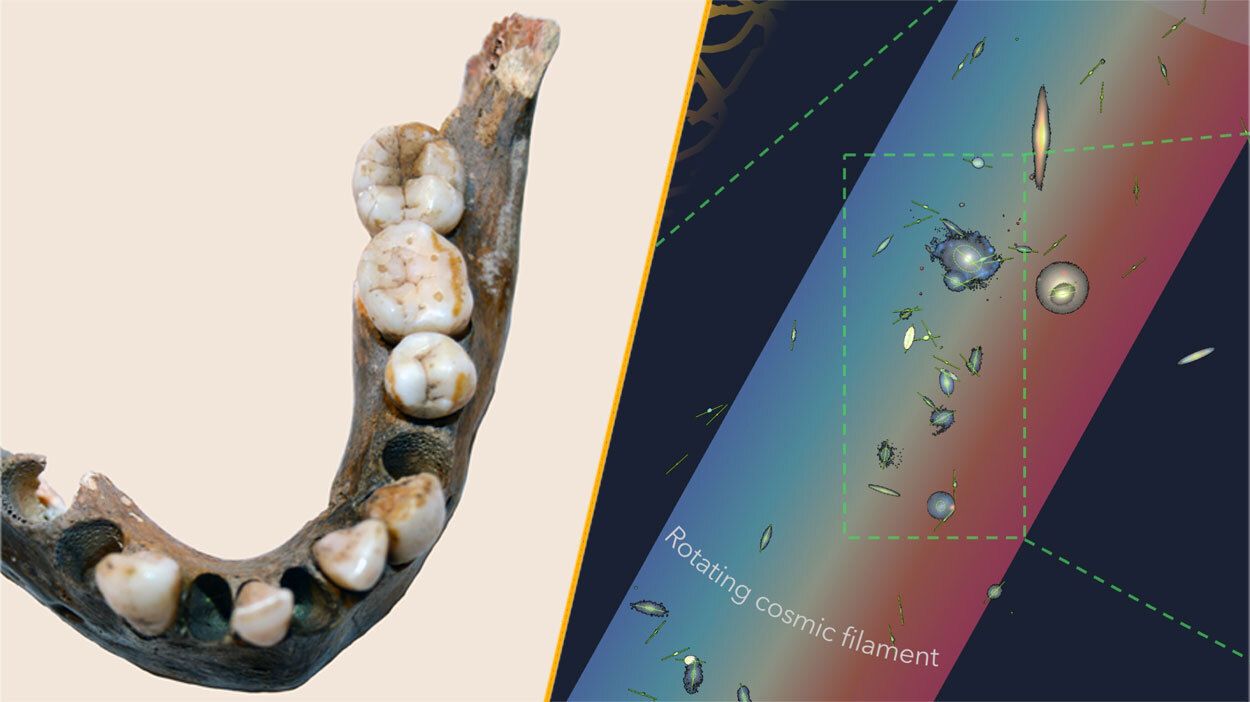
This week, significant scientific discoveries emerged, spanning vast distances in space and deep into human history. Researchers unveiled the largest spinning structure in the universe, located approximately 140 million light-years away, while studies in southern Africa revealed a human population that had been genetically isolated for 100,000 years.
Stellar Discoveries and Ancient Populations
The newly identified colossal rotating filament, wider than the Milky Way, is connected to a chain of 14 galaxies. This massive structure spins at an impressive speed of around 68 miles per second (110 kilometers per second). Astronomers utilized a series of observations to uncover this remarkable feature, highlighting the vast and dynamic nature of the universe.
In stark contrast, scientists turned their attention to southern Africa, where they studied ancient human skeletons dating back up to 10,000 years found south of the Limpopo River. These remains, some of which are over 1,400 years old, exhibited a genetic makeup dramatically different from that of modern humans. Researchers noted that this population represents “an extreme end of human genetic variation,” shedding light on the complexities of human evolution.
Archaeological Mysteries and Modern Environmental Challenges
Meanwhile, in China, archaeologists uncovered a massive pit filled with skulls near a 4,000-year-old city. Intriguingly, nearly all the skulls belonged to males, diverging from typical sacrificial patterns observed in nearby sites. This finding raises questions about the social and cultural practices of ancient civilizations.
In Greece, a remarkable tomb dating back 2,700 years contained a woman adorned with an upside-down crown, further complicated by the lack of context surrounding such a burial. These findings challenge established narratives about historical practices and beliefs.
Turning to contemporary issues, a long-term ecosystem engineering initiative in China, part of the Great Green Wall project aimed at combating desertification, has led to unintended consequences. Recent analyses indicated that while tree-planting efforts were successful, they disrupted rainfall and evaporation patterns, resulting in lower water levels in densely populated regions.
In another intriguing development, researchers suggested that the record temperature set in Death Valley in 1913 may be attributed to human error. Additionally, a key Atlantic current’s potential collapse could lead to prolonged droughts across Europe, highlighting the delicate balance of Earth’s climate systems.
Innovative Technology and Interstellar Insights
In the realm of space exploration, the interstellar comet 3I/ATLAS has captivated scientists since its discovery. Recent observations from the Joan Oró Telescope in northeastern Spain revealed that the comet exhibits spiral jets, possibly indicative of “ice volcanoes.” As it nears the sun, the comet brightens rapidly, suggesting that ice is sublimating from its surface, similar to other celestial bodies in our solar system.
On the technology front, engineers at MIT announced a groundbreaking method to extract drinking water from air, even in arid regions. This innovative technique uses sound waves to efficiently harvest water, achieving results in minutes rather than hours or days. While the device requires a power source, researchers are exploring solar cell integration to enhance its feasibility.
As the scientific community continues to push boundaries, discoveries like these not only expand our understanding of the universe but also challenge our perceptions of history, technology, and the environment.
























