




































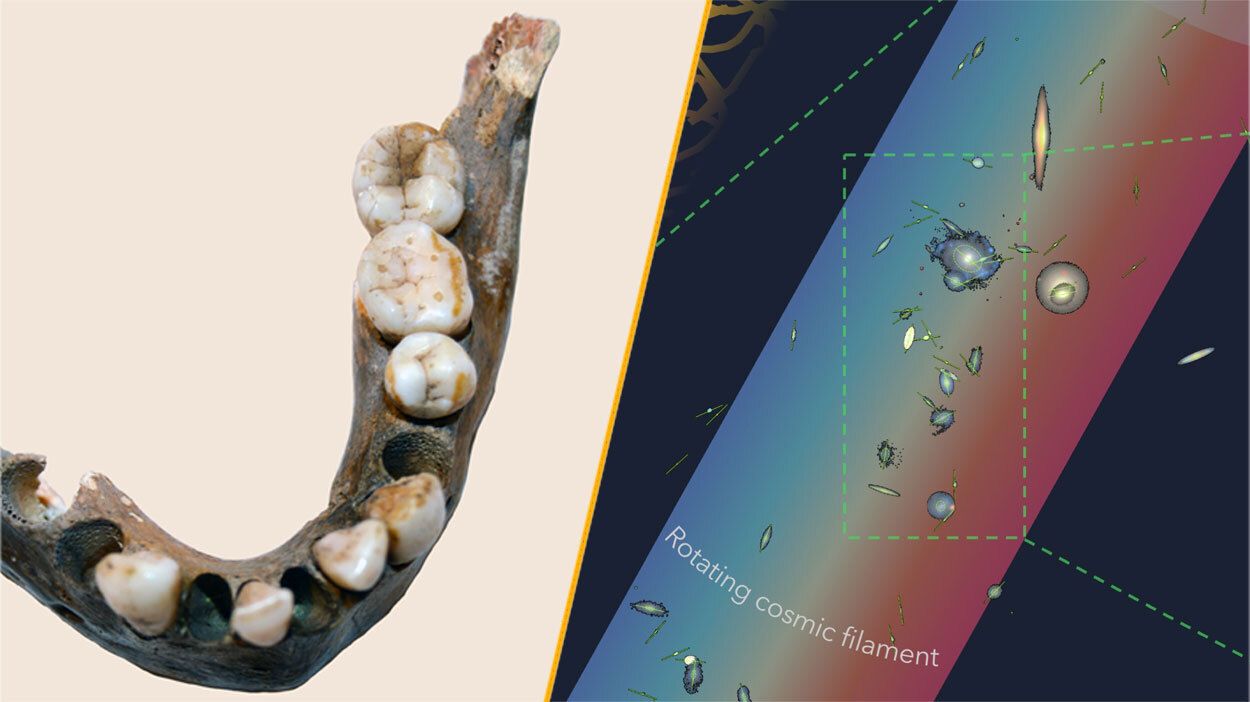
This week, major scientific discoveries captured global attention, ranging from the identification of the universe’s largest spinning structure to significant archaeological findings of ancient human remains in southern Africa. These revelations not only expand human knowledge but also prompt questions about our past and the present state of our environment.
Cosmic Discoveries and Archaeological Findings
Astronomers have identified a vast spinning filament located approximately 140 million light-years from Earth, representing the largest known rotating structure in the universe. This enormous filament, which measures wider than the Milky Way, is linked to a network of 14 galaxies and spins at an impressive rate of around 68 miles per second (110 kilometers per second). This discovery sheds light on the complex structures that exist beyond our galaxy.
In southern Africa, researchers have uncovered a human population that remained genetically isolated for 100,000 years. The analysis of skeletons, some as old as 10,000 years, found south of the Limpopo River, reveals that these individuals exhibited a significantly different genetic makeup compared to modern humans. The study highlights that these ancient people “form an extreme end of human genetic variation,” according to the research team.
On the other side of the globe, archaeologists in China have unearthed a pit filled with male skulls just outside the gates of a 4,000-year-old city. This unusual find deviates from typical sacrificial patterns found in nearby settlements, raising questions about the cultural practices of the time. Additionally, a 2,700-year-old tomb in Greece has intrigued researchers due to its contents, which included a female occupant adorned with an upside-down crown.
Environmental Impact and Technological Innovations
In contemporary environmental news, a tree-planting initiative known as the Great Green Wall in China, aimed at combating desertification, is experiencing unintended consequences. A new analysis indicates that the project has altered rainfall and evaporation patterns, resulting in lower water levels in some of the country’s most populous regions.
Research also suggests that the record temperature recorded in Death Valley in 1913 may have been influenced by human error. Scientists are now reassessing the accuracy of this historical measurement, which has stood for over a century. Moreover, a potential collapse of a critical Atlantic current poses risks of prolonged drought conditions across Europe, emphasizing the fragility of our climate systems.
Turning to innovation, engineers at MIT have developed a groundbreaking method to extract potable water from air. This technology can convert moisture into drinking water in just minutes using sound waves, making it 45 times more efficient than traditional evaporation methods. The researchers are optimistic about pairing this device with solar cells to create a sustainable power source.
In the realm of space exploration, interstellar comet 3I/ATLAS has captured the fascination of scientists and the public alike. Recent observations from the Joan Oró Telescope in northeastern Spain revealed that the comet is exhibiting signs of “ice volcanoes,” as it heats up and brightens while approaching the sun. This behavior is reminiscent of other celestial bodies within our solar system.
As scientific inquiry continues to unveil the mysteries of our universe and our planet, these discoveries remind us of the interconnectedness of ancient history, modern technology, and our environment. The week’s findings not only enrich our understanding but also challenge us to reflect on our place within this vast cosmos.