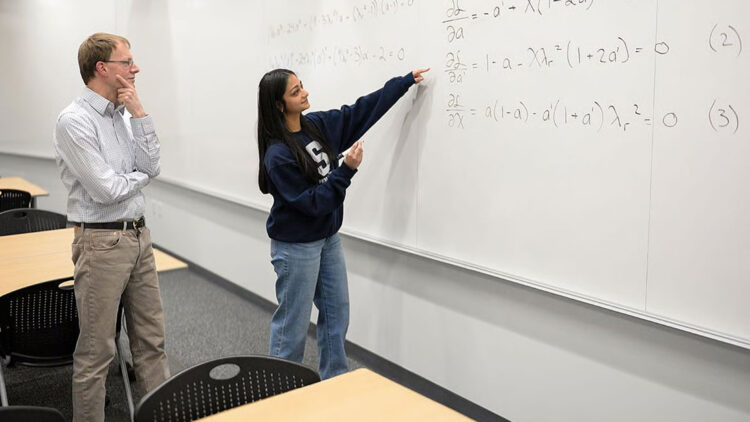
A graduate student at Penn State University, Divya Tyagi, has made a significant breakthrough in wind turbine efficiency by solving a long-standing mathematical problem known as the Glauert problem. This issue, which has perplexed engineers and mathematicians for over a century, addresses the optimal aerodynamic performance of wind turbines. Tyagi’s innovative approach not only clarifies the original theory but also enhances energy production potential from wind.
The Glauert problem, devised by British aerodynamicist Richard Glauert, has been instrumental in wind turbine design. Despite its historical relevance, experts noted that the original formulation lacked clarity and certain crucial steps. Sven Schmitz, Tyagi’s thesis supervisor, recognized these shortcomings early on. He stated, “When I thought about the Glauert problem, I thought steps were missing and it was very complicated. I suspected that there had to be another, more elegant way to solve the problem. That’s when Divya came in.”
Tyagi’s commitment to re-evaluating this century-old problem has led to a clearer method for calculating the ideal flow conditions around a wind turbine. “I created an addendum to Glauert’s problem which determines the optimal aerodynamic performance of a wind turbine by solving for the ideal flow conditions in order to maximize its power output,” she explained.
In her research, she employed a sophisticated mathematical technique known as the calculation of variations. This method helps identify the best possible solutions under specific constraints. Schmitz highlighted a critical aspect missing from Glauert’s original work: “You need to understand how large the total load is, which Glauert did not do.” By addressing this gap, Tyagi’s findings have become more applicable for engineers involved in real-world turbine design.
Impact of a 1% Improvement
The implications of Tyagi’s work are substantial. She noted that a mere 1 percent improvement in the power coefficient of a large wind turbine can lead to significant enhancements in energy production. “A 1 percent improvement in power coefficient could notably increase a turbine’s energy output, potentially powering an entire neighborhood,” she stated.
Schmitz believes that Tyagi’s findings will extend beyond academic circles. “As for Divya’s elegant solution, I think it will find its way into the classrooms, across the country, and around the world,” he said. This highlights the potential educational impact of her research, paving the way for future generations of engineers to benefit from her advancements.
Recognition and Future Endeavors
Reaching this remarkable conclusion required immense dedication. Tyagi spent approximately 10 to 15 hours a week on the problem, balancing her thesis writing and extensive research. Reflecting on her journey, she expressed pride in the effort she invested, stating, “I feel really proud now, seeing all the work I’ve done.”
Her thesis earned her the Anthony E. Wolk Award, recognizing it as the best aerospace engineering work among her peers. Furthermore, her study was published in the scientific journal Wind Energy Science, providing a platform for other researchers to utilize and expand upon her findings.
Currently, Tyagi is continuing her postgraduate education, focusing on computational fluid dynamics simulations. She is involved in a project sponsored by the United States Navy, which examines airflow around helicopter rotors, aiming to enhance flight simulations and pilot safety.
As Tyagi’s research progresses, it is anticipated that her refined version of the Glauert problem could become a new standard in wind energy studies. The potential for her work to influence both academic instruction and practical engineering applications underscores the importance of her contributions to the field.