
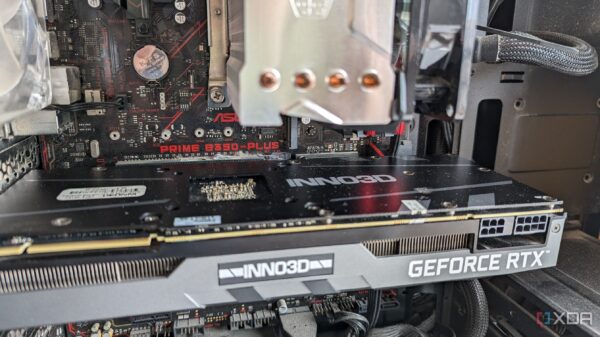







































UPDATE: PC users are being warned that sticking with aging motherboards could severely limit the performance of their new graphics cards. As of October 2023, experts confirm that failing to upgrade to a modern motherboard can hinder the capabilities of advanced GPUs.
Many gamers have traditionally upgraded their graphics cards while retaining older CPUs and motherboards. However, this practice may soon backfire as new technological advancements require more robust hardware to function optimally. Features like PCIe 4.0 and PCIe 5.0 support, Resizable BAR (ReBAR), and DDR5 RAM are critical for maximizing GPU performance.
The implications of these limitations are significant: using a PCIe 3.0 slot may lead to substantial performance drops, especially for professional tasks like video editing, where render times can skyrocket. While gaming may only see a 3-4% decrease in performance under PCIe 3.0, the impact can be far worse for intensive workloads.
Experts emphasize that upgrading your GPU without also transitioning to a modern motherboard may result in crippling limitations. The PCIe bandwidth is crucial for the communication between the graphics card and the CPU. While newer GPUs are not yet fully utilizing PCIe 4.0 bandwidth, relying on PCIe 3.0 can significantly hinder performance, particularly for high-demand applications.
Moreover, the absence of official ReBAR support on older motherboards can lead to performance losses between 10-15% in gaming and potentially more in professional workloads. ReBAR allows the CPU to access the GPU’s entire VRAM at once, significantly boosting performance. Only specific CPUs, including the AMD Ryzen 3000 and Intel Core 10th Gen, and newer GPUs, like the RTX 3000 and RX 6000, support this feature.
The shift to DDR5 RAM is also becoming increasingly critical. Recent data shows that upgrading from DDR4 to DDR5 can yield performance enhancements ranging from 10% to 35% on systems using CPUs like the Intel Core i5-12400F. As RAM prices stabilize, PC users must weigh the costs versus performance benefits of upgrading their entire platform.
PC enthusiasts are encouraged to consider a comprehensive upgrade, including a new motherboard, CPU, and RAM, rather than piecemeal improvements. This approach will ensure that they harness the full potential of their new graphics cards and avoid bottlenecks that could limit performance.
As the gaming and professional computing landscape evolves, now is the time for users to assess their systems critically. Upgrading may not be cheap, but delaying necessary updates could mean falling behind in performance, efficiency, and ultimately, enjoyment.
Stay tuned for further updates as this story develops, and consider sharing this critical information with fellow PC users who need to know about the potential limitations of their current setups.