







































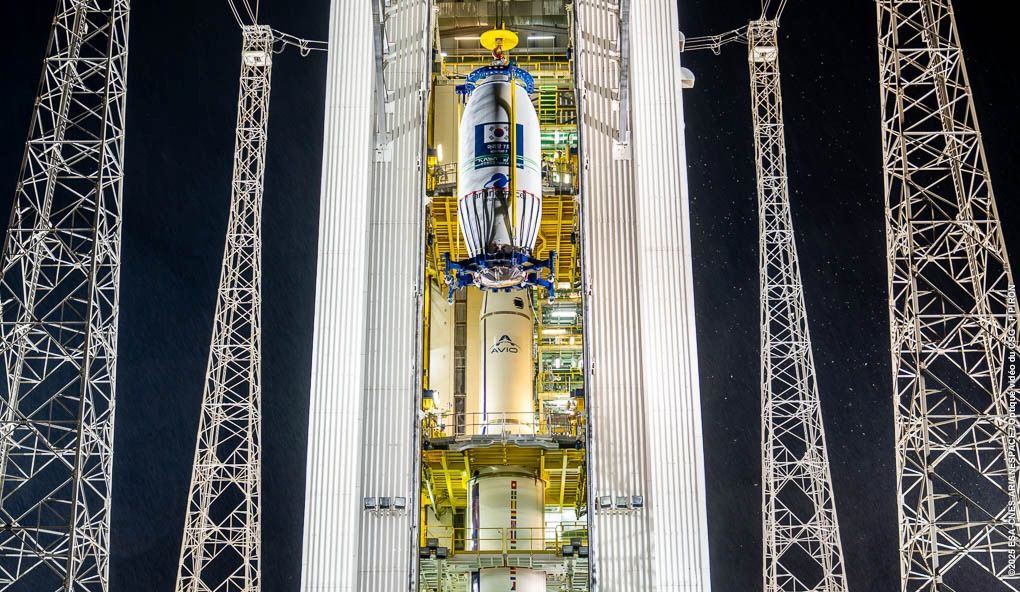
A European rocket is set to launch the South Korean Earth-observation satellite, KOMPSAT-7, into orbit today, December 1, 2023. The launch will take place from the European Spaceport in Kourou, French Guiana, at 12:21 p.m. EST (17:21 GMT; 2:21 p.m. Kourou time). This mission, designated as VV28, is being conducted by Arianespace, which will stream the event live for viewers worldwide.
The KOMPSAT-7 satellite, weighing approximately 3,990 pounds (1,810 kilograms), was developed by the Korea Aerospace Research Institute (KARI) and is positioned as one of the most advanced ultra-high-resolution optical satellites globally. It serves as a successor to KOMPSAT-3A, which was launched in March 2015. Arianespace highlighted that the new satellite is designed to meet the increasing demand for high-quality satellite imagery, particularly for detailed observations of the Korean Peninsula.
Innovative Technology and Features
KOMPSAT-7 incorporates groundbreaking optical data transmission technology, marking a first for South Korean satellites. This capability allows for real-time processing of large volumes of Earth-observation imagery through advanced electro-optical modules and onboard storage and processing systems. The satellite’s design reflects a commitment to enhancing the quality and efficiency of satellite imagery, crucial for various applications including environmental monitoring and urban planning.
The Vega C rocket, which stands 115 feet (35 meters) tall, is in the midst of its sixth mission. Developed by the European Space Agency, the rocket has had a mixed track record, with four of its five previous launches successful. The only failure occurred during its second mission in December 2022. If today’s launch proceeds as planned, KOMPSAT-7 will be deployed into a sun-synchronous orbit (SSO) approximately 358 miles (576 kilometers) above Earth, around 44 minutes after liftoff.
Satellites in sun-synchronous orbits are capable of consistently passing over the same area of Earth at the same solar time each day, ensuring uniform lighting conditions for observations. This characteristic makes SSO an ideal choice for Earth-monitoring missions, enhancing the accuracy and reliability of the data collected.
Arianespace’s live coverage of the launch will provide a unique opportunity for audiences to witness this significant event in satellite technology and international cooperation in space exploration. As the launch approaches, anticipation builds for the role KOMPSAT-7 will play in advancing Earth-observation capabilities for South Korea and beyond.