







































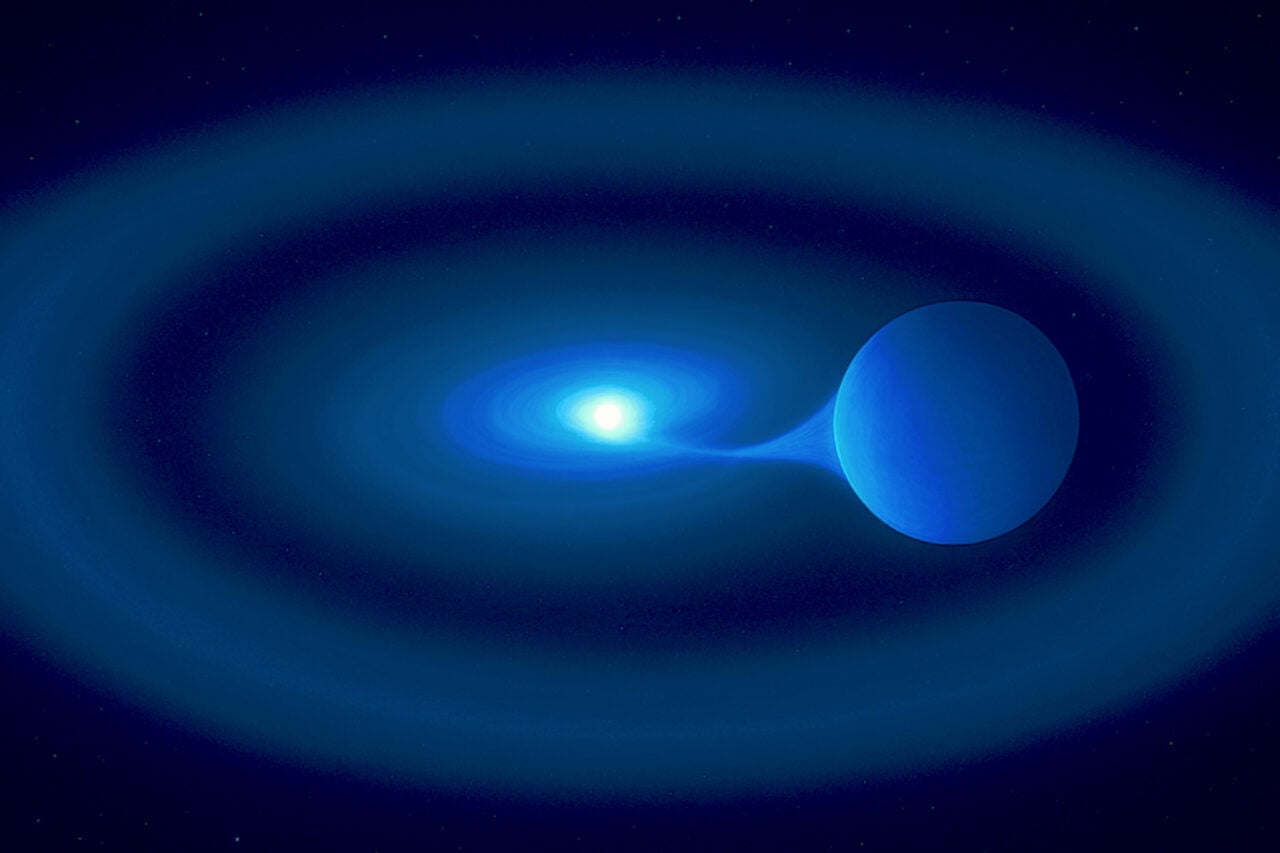
A binary star system known as V Sagittae is set to undergo a spectacular transformation, culminating in a supernova explosion bright enough to be seen from Earth during the day. This revelation follows a study published in August 2023 in the Monthly Notices of the Royal Astronomical Society, which identifies the mechanism behind the system’s extraordinary brightness.
Located approximately 10,000 light-years from Earth, V Sagittae consists of a super-dense white dwarf consuming its larger companion star at an unprecedented rate. According to researchers, the eventual collision of these two stars will lead to an explosion of exceptional luminosity, projected to occur “in the coming years.”
Understanding the Brightness of V Sagittae
The findings reveal that V Sagittae is not an ordinary star system; it has puzzled astronomers since its discovery in 1902. Phil Charles, a co-author of the study and researcher at the University of Southampton, noted, “This extreme brightness is down to the white dwarf sucking the life out of its companion star, using the accreted matter to turn it into a blazing inferno.” The intense process on the surface of the white dwarf is expected to create a thermonuclear reaction, making it shine like a beacon in the night sky.
Researchers utilized the powerful Very Large Telescope at the European Southern Observatory in Chile to observe the binary system, which orbits every 12.3 hours. Their observations also unveiled a massive ring of gas surrounding the two stars, formed from debris and energy generated by the white dwarf’s consumption of material.
Co-lead author Pasi Hakala from the University of Turku explained that the white dwarf cannot fully absorb all the mass transferred from its hotter twin. “It creates this bright cosmic ring,” he elaborated, indicating that the chaotic movement of the binary stars is a sign of its impending, violent end.
A Brilliant Future: The Nova and Supernova Events
Looking ahead, Pablo Rodríguez-Gil, another co-lead author from the Instituto de Astrofísica de Canarias and the University of La Laguna, predicted that the accumulating matter on the white dwarf will likely trigger a nova outburst. This explosion would make V Sagittae visible to the naked eye from Earth.
Ultimately, the collision of the two stars will result in a supernova explosion of unprecedented brightness. Rodríguez-Gil emphasized, “This would be a supernova explosion so bright it’ll be visible from Earth even in the daytime.” As researchers continue to study V Sagittae, they hope to enhance our understanding of stellar life cycles and the cosmic phenomena that accompany them.
The impending fate of V Sagittae not only captivates astronomers but also offers a glimpse into the dynamic processes that govern the universe, highlighting the intricate interactions between celestial bodies.