








































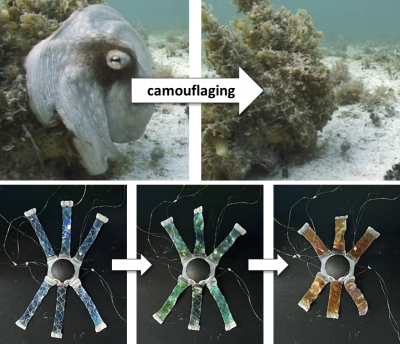
A team of researchers led by Dr. Dae-Yoon Kim at the Korea Institute of Science and Technology (KIST) has developed an innovative soft robot named ‘OCTOID.’ This advanced robot is capable of changing its color and shape, drawing inspiration from the remarkable camouflage and movement abilities of octopuses. The project highlights significant advancements in robotics, particularly in the field of soft robotics.
OCTOID represents a leap forward in robotic design. Unlike traditional robots that often rely on rigid structures, this integrated soft robot utilizes a unique mechanism to change color in response to electrical stimulation. It is designed not only to adapt its appearance to blend into various environments but also to move in ways that mimic the fluid motions of an octopus. This enables OCTOID to grasp objects effectively, showcasing its versatility and potential applications.
Innovative Design Inspired by Nature
The development of OCTOID reflects a broader trend in robotics that seeks inspiration from biological organisms. The octopus, known for its extraordinary ability to change color and shape, serves as an ideal model for this technology. By imitating these natural processes, the research team aims to create robots that can navigate complex environments and perform tasks that require a high degree of flexibility and adaptability.
The research conducted at the Functional Composite Materials Research Center of KIST has incorporated advanced materials that allow OCTOID to exhibit both softness and functionality. These materials enable the robot to respond dynamically to its surroundings, enhancing its capacity for interaction in real-world scenarios.
Potential Applications and Future Prospects
The implications of this technology extend beyond mere novelty. The ability of OCTOID to change color and shape opens the door to numerous applications in fields such as search and rescue, medical devices, and environmental monitoring. For instance, robots like OCTOID could be deployed in hazardous environments where human presence is limited, providing critical assistance while remaining unobtrusive.
As research continues, the team at KIST, under the leadership of Sangrok Oh, is exploring further enhancements to OCTOID’s capabilities. The goal is to refine the robot’s design and improve its functionality, making it even more effective in practical applications.
The unveiling of OCTOID marks an exciting chapter in the evolution of soft robotics, demonstrating how nature can inspire technological advancements. This innovative robot not only showcases the ingenuity of its creators but also poses intriguing questions about the future of robotic design and its potential impact on society.