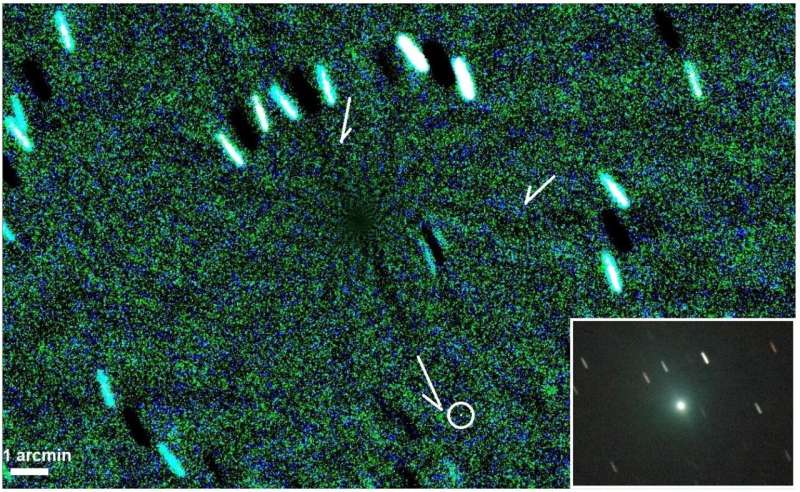
A recent study of Comet 3I/ATLAS has unveiled remarkable features that could redefine our understanding of comet formation. Researchers discovered that this second confirmed interstellar comet might be covered with cryovolcanoes, or icy volcano-like structures, which could alter existing models of comet composition and behavior. The study, published on December 3, 2025, offers insights into the comet’s unique characteristics and its implications for planetary science.
Comet 3I/ATLAS, tracked from July to November 2025, presented a rare opportunity to observe an object that has traversed interstellar space without significant alteration. The comet retains its original form, having never come close enough to a star to experience the heating or melting that typically affects celestial bodies. This pristine state makes it a valuable specimen for scientists seeking to understand the formation of comets.
Unique Characteristics and Cryovolcanism
Photometric observations indicated a significant increase in brightness when the comet was approximately 2.5 astronomical units from the sun. This surge was not a fleeting event but a sustained brightness, suggesting the activation of water-ice layers across the entire surface. Researchers believe this activity is attributed to cryovolcanism, which differs from the traditional understanding of comet behavior.
Unlike many comets in our solar system, Comet 3I/ATLAS lacks a protective dust mantle, allowing for global activation of its icy surface. When researchers analyzed the light reflected from the comet and compared it to meteorite samples on Earth, they found a match with a rare type known as carbonaceous chondrites. These meteorites are ancient and rich in metals, such as iron and nickel, leading scientists to conclude that Comet 3I/ATLAS shares a similar composition.
The study’s authors, including lead researcher Josep M. Trigo-Rodríguez, suggest that the comet’s metal-rich composition significantly contributes to its cryovolcanic activity. As the surface warms and ice transforms into liquid water, chemical reactions with fine metal grains inside the comet generate additional energy and gases. This reaction fuels the sustained cryovolcanism observed.
Implications for Comet Formation Theories
The findings from Comet 3I/ATLAS challenge traditional models of comet formation, which typically posit that comets are comprised of a mixture of ice, rock, and lower metal concentrations. These models suggest that comets are primarily powered by solar heating. In contrast, the evidence gathered from Comet 3I/ATLAS indicates a more complex formation process, suggesting a broader diversity in the characteristics and behaviors of comets.
In their analysis, the research team emphasizes the importance of interstellar objects like Comet 3I/ATLAS in refining our understanding of planetary-system formation and the chemical evolution of small celestial bodies. The study highlights how these alien visitors can reshape our comprehension of the universe and its origins.
This article is the result of careful research and fact-checking by professionals in the field, including Paul Arnold, Gaby Clark, and Robert Egan. For further details, readers can refer to the study published on arXiv with the DOI: 10.48550/arxiv.2511.19112. The ongoing exploration of our solar system and beyond relies on the support of the public to maintain independent science journalism.