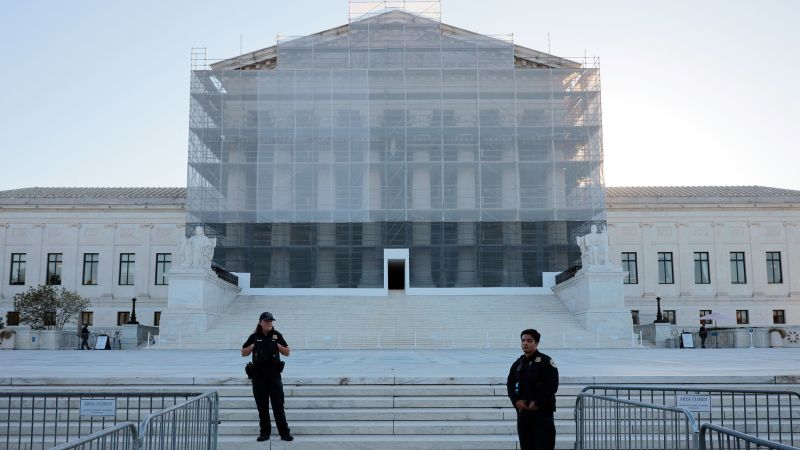
On Monday, the Supreme Court will address a significant legal dispute concerning President Donald Trump’s authority to dismiss officials from independent agencies, specifically focusing on the recent firing of Rebecca Kelly Slaughter from the Federal Trade Commission (FTC). This case could potentially reshape governance structures established since the era of President Franklin D. Roosevelt, revisiting the balance of power within federal agencies.
The heart of the matter lies in Trump’s decision in March to remove Slaughter, despite a federal law stipulating that FTC members can only be dismissed for reasons such as “inefficiency, neglect of duty, or malfeasance in office.” Trump has not provided any justification for her removal that aligns with these criteria. This case follows months of legal debates regarding the extent of the president’s power over independent agencies, which are designed to operate free from political influence.
The Supreme Court’s upcoming ruling is expected to have far-reaching implications, potentially affecting numerous cases that raise similar questions about the separation of powers. The dispute could challenge a long-standing precedent set in the 1935 case, Humphrey’s Executor v. US, which allowed Congress to dictate the terms for the removal of leaders from independent agencies. This precedent has been under scrutiny from the court’s conservative majority, which has expressed skepticism towards for-cause protections for executive branch officials.
In a legal brief, Slaughter’s attorneys argued that overturning a precedent of this magnitude would severely disrupt established institutions integral to the functioning of American governance. Conversely, Trump’s administration has posited that the founding fathers envisioned a president with broad oversight over the executive branch. D. John Sauer, the Solicitor General, described independent agencies as a “myth,” warning against the dangers of a “fourth branch” of government that operates without accountability to elected officials.
The Supreme Court, currently holding a 6-3 conservative majority, previously indicated its reservations about protections for independent agency heads. In a notable case four years ago, the court ruled that protections for the head of the Consumer Financial Protection Bureau violated principles of separation of powers. Chief Justice John Roberts noted that the president’s authority to remove and supervise those wielding executive power is derived directly from the Constitution.
The upcoming case regarding Slaughter also raises questions about the judiciary’s role in intervening in executive branch matters. The court will consider whether it has the authority to prevent a person’s removal from public office, a significant issue since the original Humphrey’s case pertained to back pay rather than reinstatement. This could set a precedent that limits the courts’ ability to mandate the reinstatement of dismissed officials.
Additionally, the court has recently linked Slaughter’s case to another appeal involving a Library of Congress official, suggesting that justices see a connection between the two situations. Slaughter was first appointed to the FTC by Trump in 2018, and was later nominated for a second term by former President Joe Biden, receiving unanimous Senate approval last year.
The FTC consists of five members, appointed by the president, who serve seven-year terms, ensuring that no more than three commissioners belong to the same political party. The agency plays a crucial role in enforcing antitrust and consumer protection laws. In July, a federal district court ordered Slaughter’s reinstatement, but an appeals court in Washington, D.C., opted not to overturn this ruling.
Earlier this year, the Supreme Court permitted Trump to dismiss leaders of independent agencies appointed by Biden, many of whom were anticipated to oppose his policies. In September, the court allowed the Trump administration to keep Slaughter sidelined while the case progressed.
The Humphrey’s Executor case from 1933 involved the dismissal of William Humphrey, a commissioner of the FTC appointed by President Herbert Hoover. Humphrey continued to assert his position until his death in 1934. His estate sought to reclaim his salary for the period following his firing, leading the Supreme Court to unanimously determine that his dismissal was improper. The justices noted that someone serving “at the pleasure” of another cannot be relied upon to maintain independence against the will of that authority.
As the Supreme Court prepares to hear this pivotal case, the implications of its decision could echo throughout the federal government, potentially redefining the balance of power between the presidency and independent agencies.