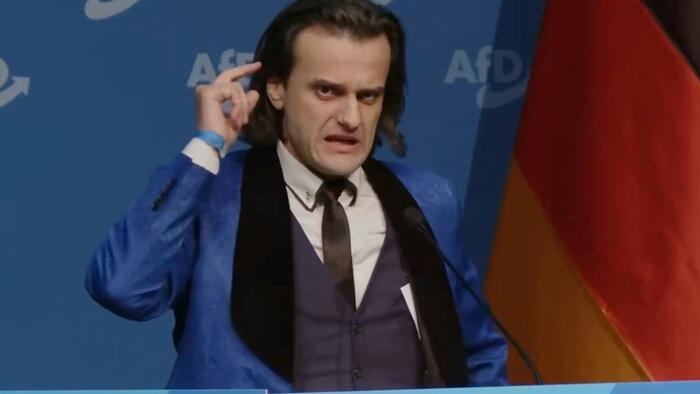
A recent speech at the Alternative for Germany (AfD) Youth Congress in Giessen has ignited a wave of speculation surrounding Alexander Eichwald, a man who delivered a provocative address that drew comparisons to Adolf Hitler. Following his performance, questions emerged regarding Eichwald’s identity, with observers debating whether he is a genuine supporter, a left-wing satirist, or possibly an undercover agent. The AfD has announced plans to expel him from the party, escalating the controversy.
Eichwald’s speech, which included references to “party comrades” and controversial remarks about selecting individuals based on dog breeds, quickly went viral. His rhetoric prompted reactions from various factions within the party, as many on the right voiced suspicions that he might be an undercover agent. During the address, Eichwald positioned himself as a candidate for the newly established “Generation Germany” board but received only 12 percent of the votes, losing to Alexander Claus.
The newly elected leader of the AfD’s youth group, Jean-Pascal Hohm, expressed his disapproval of Eichwald’s actions, stating, “No matter whether you’re a left-wing provocateur, an undercover agent or simply crazy – anyone who acts like that has no place in the AfD and its youth organization.” Hohm emphasized the need for thorough vetting during admission interviews to ensure that individuals accepted into the party align with its values.
Party’s Response and Investigation
In the wake of the incident, the AfD’s co-leader, Tino Chrupalla, announced an audit of Eichwald’s membership records, noting that he had only joined the NRW-AfD in Herford in October. Chrupalla confirmed that Eichwald has been removed from the AfD council as part of a circular resolution passed on December 1, 2025, aimed at initiating a formal expulsion process. He stated, “Accordingly, the measure was also taken to aim yesterday by circular resolution to exclude Mr. Eichwald from the party through a party expulsion procedure.”
The controversy has drawn attention not only from party members but also from the media. Michael Schneidermann, the leader of the AfD parliamentary group in Herford, characterized Eichwald’s behavior as “absolutely unmasked.” He noted that Eichwald, who presented himself as a political scientist and student interested in local politics, had damaged the reputation of the newly formed youth wing of the party.
Speculation continues regarding Eichwald’s true motives. Some party members have suggested that his speech may have been a deliberate act of provocation, potentially linked to a satirical background. Despite the growing confusion, as of now, there has been no definitive identification of Eichwald’s intentions or affiliations.
The fallout from this incident highlights the tensions within the AfD and raises significant questions about party membership and the vetting processes in place. As the situation evolves, the AfD faces scrutiny not only from within but also from the public and media, all keen to understand the implications of Eichwald’s appearance and the party’s response.
In a political landscape already fraught with division, this incident has opened up discussions about the challenges faced by political parties in managing their public image and internal coherence. The AfD’s handling of the matter will likely have repercussions on its standing both among supporters and critics in the coming weeks.