








































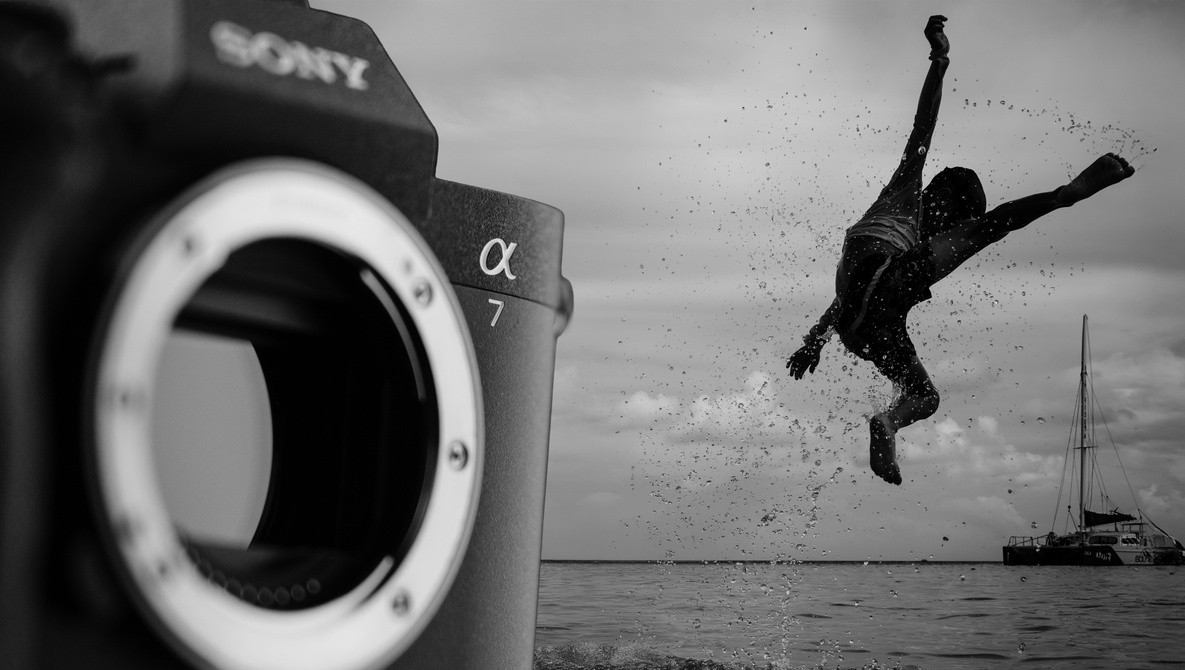
The new Sony a7 V camera has been put to the test in various real-world settings, including a week-long family trip to Aruba and several mini portrait sessions. With its advanced 33 MP partially stacked sensor, this model boasts an impressive 16 stops of dynamic range, making it a versatile option for photographers seeking high-quality performance in diverse conditions.
During the evaluation, approximately 6,000 images were captured, focusing on the silent shutter feature. This is particularly noteworthy as the a7 V’s sensor design addresses previous issues with slow readout speeds that resulted in motion distortion, commonly referred to as the “jello effect.” Unlike older models, the partially stacked sensor in the a7 V allows for significantly faster readouts, although it does not achieve the same speeds as fully stacked sensors or global shutters.
To examine the sensor’s capabilities, subjects were photographed in motion, including a child swinging a rake and another quickly swinging a plastic sword. The results indicated minimal distortion, showcasing the a7 V’s effectiveness in electronic shutter mode for everyday scenarios. Images of a child running into the ocean also reflected the camera’s proficiency in capturing fast-paced action, with the electronic shutter performing well under typical conditions.
The camera can shoot at 30 frames per second, which allows for impressive burst shooting capabilities. While some may compare this to the Canon model that achieves 40 frames per second, the a7 V’s ability to capture 14-bit raw files without blackout during bursts gives it an edge for certain users. Features like pre-capture mode, which buffers images before the shutter is pressed, and a boost button for increased frame rates, further enhance its usability for capturing fleeting moments.
Despite its strengths, there are areas where the a7 V could improve. The body design, while functional, lacks certain features found in the a9 III, such as the C5 button. However, it does include an enhanced tilting screen that offers flexibility for various shooting angles. Additionally, the custom button functionality has been improved, allowing users to switch between shutter types without navigating through menus, although further enhancements could benefit other settings as well.
The Bionz XR2 processor in the a7 V has streamlined processing, leading to enhanced autofocus accuracy, color fidelity, and better battery life. The camera is rated for 630 images when using the electronic viewfinder and 750 images with the rear screen, demonstrating its capability to handle long shooting sessions without needing a recharge.
One feature designed for usability is the screen blackout mode, which turns off the display to conserve battery while allowing for quick activation. However, a design flaw exists whereby the electronic viewfinder sensor can trigger screen activity when the camera is worn, preventing the screen from turning off as intended.
For video capabilities, the a7 V supports 7K oversampled 4K60 with full pixel readout, ensuring high-quality footage without cropping. It can also shoot 4K120 in a Super 35 crop or full HD at 240 frames per second. While primarily a stills camera, its video features make it a compelling choice for those needing versatility.
The a7 V offers a single combo slot and an additional slot limited to SD cards, which may raise questions about its design compared to other models in the series. Nevertheless, it includes two USB-C ports—one for USB 3.2 Gen 2 and another for USB 2.0—enhancing tethering options without the need for dummy batteries, although some users may prefer a second combo slot instead.
In conclusion, the Sony a7 V presents itself as an exceptional option for wedding and portrait photography, balancing high resolution and frame rates with advanced autofocus and video capabilities. For photographers who do not require extreme readout speeds or the unique features of the a9 III, the a7 V stands out as a more cost-effective solution without compromising quality. Personal experiences suggest that for general photography needs, the a7 V may well be the ideal choice, combining enhanced dynamic range with superior performance across various lighting conditions.
Jason Vinson, a wedding and portrait photographer based in Bentonville, Arkansas, emphasizes the a7 V’s potential in diverse photographic scenarios, making it a worthy investment for both enthusiasts and professionals alike.
























